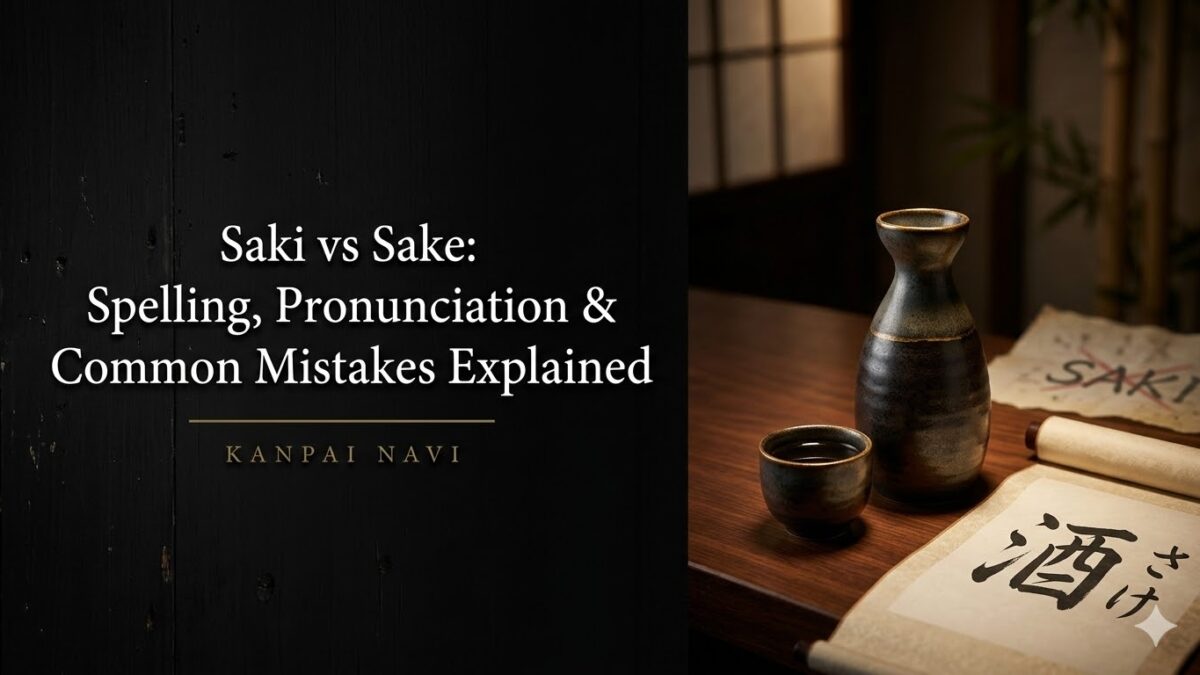
Saki vs Sake: Spelling, Pronunciation & Common Mistakes Explained
What You’ll Learn in This Article
- Why “sake” is the only correct spelling — and “saki” is a Japanese girl’s name, not a drink
- How to pronounce sake correctly: “sah-keh,” not “sah-kee”
- Why English phonetics push speakers toward the wrong pronunciation every time
- How pronunciation varies across Japan’s regions — and why even native speakers disagree
- How to confidently order sake at a Japanese restaurant without stumbling over the name
If you have ever typed “saki drink” into a search bar, you are not alone — but you have been spelling it wrong. The Japanese rice wine is spelled sake, never “saki.” And the odds are high that you are mispronouncing it too. This guide goes far beyond the simple correction to explain exactly why these mistakes happen and how to get it right.
Supervised by
Daichi Takemoto
Authentic Bartender & Owner of Obanzai Nanchatte, Kobe
With 8 years of experience as a professional bartender and now the owner of "Obanzai Nanchatte" in Kobe, Daichi brings hands-on expertise in Japanese sake, whisky, and food pairing to every article on Kanpai Navi.
Table of Contents
- Is It “Saki” or “Sake”? The Definitive Answer
- What “Saki” Actually Means in Japanese
- Why the Correct Spelling Matters
- How to Pronounce Sake Correctly
- The Correct Pronunciation: “Sah-keh”
- A Quick Phonetic Comparison Across Japanese Words
- Common Pronunciation Mistakes Ranked by Frequency
- Why English Speakers Default to “Sah-kee”
- The English Homograph Problem
- English Phonotactic Constraints
- The Misspelling Follows the Mispronunciation
- The “Saké” Accent Mark Convention
- Regional Pronunciation Variations Within Japan
- Standard Japanese (Hyōjungo) vs. Regional Dialects
- Sake vs. O-sake: The Honorific Prefix
- Sake vs. Nihonshu: When to Use Each Term
- How to Order Sake at a Japanese Restaurant
- Step-by-Step Ordering Guide
- Useful Phrases for Ordering
- What About Drinking Temperature?
- Frequently Asked Questions
- Is “saki” an acceptable alternative spelling for the Japanese drink?
- How do you pronounce sake correctly?
- Why do so many people say “sah-kee” instead of “sah-keh”?
- Should I write “sake” or “saké” with an accent mark?
- What is the difference between sake and nihonshu?
- Does it matter if I mispronounce sake at a restaurant?
- Does sake taste different depending on how you say it?
- The Bottom Line
- Sources & References
Is It “Saki” or “Sake”? The Definitive Answer
The answer is unambiguous: the drink is always spelled sake. There is no context, no regional variation, and no style guide in which “saki” correctly refers to the Japanese rice beverage.
What “Saki” Actually Means in Japanese
The spelling “saki” corresponds to a completely different Japanese word. 咲 (saki) is a Japanese girl’s first name meaning “blossom” or “bloom.” It is one of the most popular female given names in Japan, associated with cherry blossoms and spring. Writing “saki” when you mean the drink is the equivalent of writing “rose” when you mean “rows” — you have produced a real word, just the wrong one entirely.
There is also 先 (saki), meaning “ahead” or “previous,” and 崎 (saki), meaning “cape” or “promontory,” as seen in place names like Nagasaki. None of these have anything to do with alcohol.
Why the Correct Spelling Matters
Using the correct spelling is not pedantic. It affects how search engines direct you, how sommeliers and bartenders perceive your knowledge, and how you navigate Japanese menus, bottle labels, and import catalogs. If you search for “saki” online, algorithms will usually redirect you — but the misspelling signals unfamiliarity with the subject, which can shape the recommendations you receive.
| Word | Spelling | Japanese | What It Means | Use It For |
|---|---|---|---|---|
| Sake | sake | 酒 (さけ) | Japanese rice wine / alcohol in general | The alcoholic drink made from rice |
| Saki | saki | 咲 (さき) | A Japanese girl’s first name (“blossom”) | Referring to a person, not a drink |
| Sake (English) | sake | — | “Purpose” or “benefit” | English phrases like “for the sake of” |
| Saki (zoology) | saki | — | A genus of New World monkeys | Scientific and wildlife contexts |
The English word “sake” (as in “for the sake of argument”) shares the same spelling as the Japanese drink but has a completely different origin, meaning, and pronunciation. This overlap is one of several forces driving the confusion — and we will unpack all of them below.
How to Pronounce Sake Correctly
Getting the spelling right is only half the battle. The majority of English speakers who correctly write “sake” still mispronounce it. Even bartenders, food writers, and television hosts routinely get it wrong on camera.
The Correct Pronunciation: “Sah-keh”
Sake is pronounced “sah-keh” — two clean, equally weighted syllables. The breakdown is straightforward:
| Syllable | Sound | English Equivalent | Common Mistake |
|---|---|---|---|
| Sa | sah | The “sa” in “sun” or “saga” | Pronouncing it like “say” |
| Ke | keh | The “ke” in “kettle” or “kept” | Stretching it to “kee” as in “key” |
In Japanese phonology, every vowel has exactly one sound. The letter “e” is always pronounced “eh” — never silent, never “ee,” never “ay.” This single rule, once internalized, fixes the pronunciation of sake, karaoke, karate, and dozens of other Japanese loanwords that English speakers routinely mangle.
Think of it as stopping the word cleanly after “keh” instead of letting your voice rise into “kee.” There is no upward inflection, no trailing sound. Just two flat, equal beats: sah-keh.
A Quick Phonetic Comparison Across Japanese Words
The “eh” ending in sake follows the same pattern as many other Japanese words. Once you hear the pattern, it becomes second nature.
| Japanese Word | Correct Pronunciation | Common English Mispronunciation | What It Means |
|---|---|---|---|
| Sake (酒) | sah-keh | sah-kee | Rice wine / alcohol |
| Karaoke (カラオケ) | kah-rah-oh-keh | carry-oh-kee | Empty orchestra |
| Karate (空手) | kah-rah-teh | kuh-rah-tee | Empty hand |
| Tempura (天ぷら) | tem-poo-rah | tem-poor-uh | Battered and fried food |
| Anime (アニメ) | ah-nee-meh | an-ih-may | Japanese animation |
Common Pronunciation Mistakes Ranked by Frequency
Not all mispronunciations are equally common. Here is how they break down in practice, based on what you hear in bars, restaurants, and media across English-speaking countries.
| Pronunciation | Phonetic | Correct? | How Common | Notes |
|---|---|---|---|---|
| sah-keh | /sɑːkeɪ̯/ approx. | Yes | Rare in English | The correct Japanese pronunciation |
| sah-kee | /sɑːkiː/ | No | Extremely common | The dominant English mispronunciation |
| sakay | /sækeɪ/ | No | Occasional | Overcorrection influenced by French loanwords |
| sayk | /seɪk/ | No | Rare | The English word “sake” applied to the drink |
Daichi Takemoto
Japanese people will almost never correct you if you say “sah-kee” — we understand what you mean, and honestly, most of us are just pleased you are drinking sake at all. But if you want to get it right, remember: two short syllables, “sah-keh.” It is the same vowel sound at the end of karaoke (kah-rah-oh-keh), another word most English speakers mispronounce.
Why English Speakers Default to “Sah-kee”
The “saki vs sake” confusion is not random and it is not a sign of laziness. There are deep structural reasons in the English language that push speakers toward the wrong pronunciation and, consequently, the wrong spelling.
The English Homograph Problem
English already owns the word “sake” — pronounced “sayk” — meaning purpose or benefit, as in “for the sake of clarity.” When English speakers encounter “sake” on a Japanese menu, their brain reaches for the pronunciation it already knows. Since “sayk” does not sound Japanese, many people overcorrect to “sah-kee,” which feels more exotic and foreign. The correct “sah-keh” never enters the equation because it does not match any existing English sound pattern.
This is a textbook example of linguistic interference: a speaker’s native language actively disrupts their ability to process a foreign word. The same phenomenon explains why French speakers struggle with English “th” sounds and why English speakers cannot easily produce the German “ch.”
English Phonotactic Constraints
English has extremely rigid rules — largely unconscious — about which sounds can appear at the end of a word. The short “eh” sound almost never appears in word-final position in English. When encountering a word ending in the letter “e,” English speakers apply one of two default rules:
| English Rule | Example Words | What Happens to “Sake” |
|---|---|---|
| Silent final “e” | cake, make, lake, take | Brain reads “sayk” — the English word |
| Final “e” as “ee” | recipe, epitome, anemone | Brain produces “sah-kee” |
| Final “e” as “eh” (Japanese) | sake, karaoke, karate | This pattern does not exist natively in English |
Because English lacks the “eh” word-ending, speakers instinctively reach for the nearest familiar sound: “ee.” This is not a conscious choice. It is an automatic phonological process that operates below awareness.
The Misspelling Follows the Mispronunciation
Once “sah-kee” becomes the dominant spoken form, the misspelling “saki” follows logically. In English, words ending in an “ee” sound are very frequently spelled with a final “i”: taxi, broccoli, salami, tsunami, wasabi. A person who hears “sah-kee” and writes “saki” is applying perfectly rational English spelling rules — they are just applying them to a word that does not follow those rules.
This means the most effective fix is not to memorize the spelling separately. Fix the pronunciation first — “sah-keh” — and the correct spelling “sake” follows naturally.
The “Saké” Accent Mark Convention
You may have seen the spelling “saké” on wine lists, import labels, and in food journalism. The acute accent over the “e” is not part of the Japanese writing system — Japanese does not use accent marks. It is a Western convention borrowed from French orthography, where an acute accent signals that a final “e” should be pronounced rather than left silent.
The logic is practical: writing “saké” tells English readers “do not pronounce this like cake.” It pushes the reader toward “sah-kay” or “sah-keh,” both of which are closer to correct than “sayk.” However, “saké” introduces its own problem — the French accent suggests the “ay” sound of café, leading some readers to pronounce it “sah-kay,” which is still not quite right.
Most major style guides (AP, Chicago, New York Times) use the unaccented “sake.” The accented “saké” is acceptable in casual and commercial use but is not technically correct in either Japanese or formal English.
Do Not Overcorrect to Three Syllables
Some English speakers, upon learning the correct pronunciation, begin saying “sah-keh” with an exaggerated third beat — “sah-keh-eh” — or adding a breathy emphasis to the final syllable. This sounds unnatural. In Japanese, sake is exactly two syllables of equal weight and equal length. Do not stress either syllable more than the other. Keep it flat and clean: sah-keh.Regional Pronunciation Variations Within Japan
Here is something most pronunciation guides leave out: Japanese people themselves do not all pronounce sake identically. Japan has dozens of regional dialects (方言, hōgen), and the word sake — along with its variants — shifts across regions.
Standard Japanese (Hyōjungo) vs. Regional Dialects
The pronunciation “sah-keh” reflects standard Japanese (標準語, hyōjungo), which is based on the Tokyo dialect and used in media, education, and formal speech. But Japan’s regional landscape is more complicated.
In the Kansai region (Osaka, Kyoto, Kobe), the pitch accent on sake differs from Tokyo. Tokyo Japanese places a high-low pitch pattern on sake (SA-ke), while Kansai Japanese often uses a low-high pattern (sa-KE). The vowel sounds remain the same — “sah-keh” in both cases — but the musical contour of the word changes noticeably.
In some rural dialects of Tōhoku (northern Honshu), vowel sounds can merge or shift. The distinction between “e” and “i” sounds blurs in certain Tōhoku speech patterns, meaning some native speakers in those regions produce something closer to “sah-ki” in casual conversation. This is a dialectal feature, not the standard pronunciation, but it shows that the “ee” vs. “eh” boundary is not as rigid inside Japan as pronunciation guides suggest.
Sake vs. O-sake: The Honorific Prefix
In everyday Japanese speech, you will often hear お酒 (o-sake) rather than plain 酒 (sake). The “o” is an honorific prefix (美化語, bikago) that adds politeness and warmth. Women and service industry workers tend to use o-sake more frequently than the bare form.
If you are in Japan, using “o-sake” sounds natural and polite. It signals familiarity with how Japanese people actually speak, rather than textbook formality.
Sake vs. Nihonshu: When to Use Each Term
Once you have the spelling and pronunciation sorted, there is one more layer worth understanding — especially if you visit Japan or shop at specialist importers.
In Japanese, the kanji 酒 (sake) can mean any alcoholic drink. Beer is sake. Wine is sake. Whisky is sake. It is a broad category term for alcohol, not a specific reference to rice wine.
When Japanese people want to specify the rice wine, they use 日本酒 (nihonshu), literally “Japanese alcohol.” This distinction is critical inside Japan, where saying “sake” at a bar could genuinely mean you want any drink at all.
| Term | Japanese | Literal Meaning | Practical Usage |
|---|---|---|---|
| Sake (酒) | さけ / 酒 | Alcoholic drink | In Japan: any alcohol. Outside Japan: rice wine specifically. |
| Nihonshu (日本酒) | にほんしゅ / 日本酒 | Japanese alcohol | In Japan: rice wine specifically. Increasingly used internationally. |
| Seishu (清酒) | せいしゅ / 清酒 | Clear alcohol | The legal/tax classification term used on Japanese labels. |
Outside Japan, “sake” is universally understood to mean the rice wine, so you do not need to say “nihonshu.” But knowing the distinction helps you understand why Japanese menus and sake guides sometimes use nihonshu — they are being precise in a way the English word cannot be.
Daichi Takemoto
When I am in Japan and a customer asks for “sake,” I always ask what kind — because in Japanese it could mean anything from beer to whisky. When I speak English with international guests, I use “sake” without confusion. If you are outside Japan, say “sake” with confidence. If you are in a Japanese bar, “nihonshu” will get you exactly what you want.
How to Order Sake at a Japanese Restaurant
Knowing the correct pronunciation is one thing. Using it confidently in a real-world setting is another. Here is a practical guide to ordering sake without hesitation — whether you are at an izakaya in Tokyo or a Japanese restaurant in New York.
Step-by-Step Ordering Guide
At a Japanese restaurant outside Japan: Simply say “sah-keh” when ordering. The server will understand immediately. If the menu lists specific brands or types, try pronouncing those too — junmai (joon-my), ginjo (geen-joh), daiginjo (dye-geen-joh). Even imperfect attempts at Japanese pronunciation signal respect and genuine interest.
At a restaurant in Japan: Use “nihonshu” (nee-hon-shoo) to specify rice wine. The server may then ask whether you want it cold (冷や, hiya), warm (ぬる燗, nurukan), or hot (熱燗, atsukan). If you are unsure, saying “osusume wa?” (what do you recommend?) works beautifully.
Useful Phrases for Ordering
| Situation | Japanese Phrase | Pronunciation | English Meaning |
|---|---|---|---|
| Ordering sake | 日本酒をください | nihonshu o kudasai | Japanese sake, please |
| Asking for cold | 冷やでお願いします | hiya de onegai shimasu | Cold, please |
| Asking for warm | 燗でお願いします | kan de onegai shimasu | Warmed, please |
| Asking for a recommendation | おすすめは? | osusume wa? | What do you recommend? |
| Asking for one more | もう一杯ください | mō ippai kudasai | One more cup, please |
What About Drinking Temperature?
Sake is one of the few alcoholic beverages enjoyed across a wide temperature spectrum. When ordering, you may be asked how you want it served. Knowing the temperature terms prevents the awkward pause that follows “however it comes.”
Premium sakes — ginjo and daiginjo grades — are typically served chilled to preserve their delicate aromatics. Robust junmai and honjozo styles often shine when gently warmed. If you are unsure, asking for a recommendation based on the specific bottle is always the right move.
Frequently Asked Questions
Is “saki” an acceptable alternative spelling for the Japanese drink?
No. The drink is always spelled “sake.” The spelling “saki” corresponds to a Japanese girl’s first name (咲), meaning “blossom.” Writing “saki” when you mean the drink is a spelling error, not a variant.
How do you pronounce sake correctly?
Sake is pronounced “sah-keh” — two syllables of equal weight. The “sa” sounds like the beginning of “sun,” and “keh” sounds like the beginning of “kettle.” It is not pronounced “sah-kee,” “sakay,” or “sayk.”
Why do so many people say “sah-kee” instead of “sah-keh”?
English rarely ends words with a short “eh” sound. Speakers instinctively stretch the final vowel to “ee” — the same reason karaoke becomes “carry-oh-kee” and karate becomes “kuh-rah-tee.” The mispronunciation is so widespread that it reinforces itself through media, menus, and conversation.
Should I write “sake” or “saké” with an accent mark?
Major style guides (AP, Chicago, New York Times) use the unaccented “sake.” The accented “saké” is a Western convention borrowed from French to signal that the final “e” is pronounced. It is acceptable in casual use but is not part of Japanese writing and can lead to the slightly incorrect “sah-kay” pronunciation.
What is the difference between sake and nihonshu?
In Japanese, sake (酒) is a general word for any alcoholic drink. Nihonshu (日本酒) means specifically Japanese rice wine. Outside Japan, “sake” is universally understood to mean the rice wine, so both terms work — but nihonshu is more precise.
Does it matter if I mispronounce sake at a restaurant?
You will always be understood regardless of pronunciation. Japanese culture strongly avoids correcting guests directly. However, using the correct pronunciation signals familiarity and respect, which often leads to better recommendations and a richer experience — especially at specialist sake bars.
Does sake taste different depending on how you say it?
No — pronunciation does not change what sake tastes like. But getting the name right sets the tone for how seriously you engage with the drink, the culture, and the people serving it.
The Bottom Line
The drink is spelled sake, not “saki.” It is pronounced “sah-keh”, not “sah-kee.” The misspelling comes from the mispronunciation — people who hear “sah-kee” naturally write “saki” — so fixing the pronunciation fixes the spelling too.
Remember: two short syllables, “sah-keh,” with the soft “eh” at the end, like the “ke” in kettle. In Japan, 酒 means any alcohol, and Japanese speakers use 日本酒 (nihonshu) when they mean the rice wine specifically. Outside Japan, “sake” is all you need.
Spell it right, say it right, and you are already ahead of most people who enjoy this drink regularly.
Sources & References
- Gauntner, John. The Sake Handbook. Tuttle Publishing, 2nd edition, 2012.
- Morales, Nancy Matsumoto and Michael Tremblay. Exploring the World of Japanese Craft Sake. Tuttle Publishing, 2022.
- National Research Institute of Brewing (NRIB), Japan — official sake classification standards.
- Shibatani, Masayoshi. The Languages of Japan. Cambridge University Press, 1990. (Japanese phonology and dialectal variation.)
- The Japan Sake and Shochu Makers Association — terminology and labeling guidelines.
- Labrune, Laurence. The Phonology of Japanese. Oxford University Press, 2012.