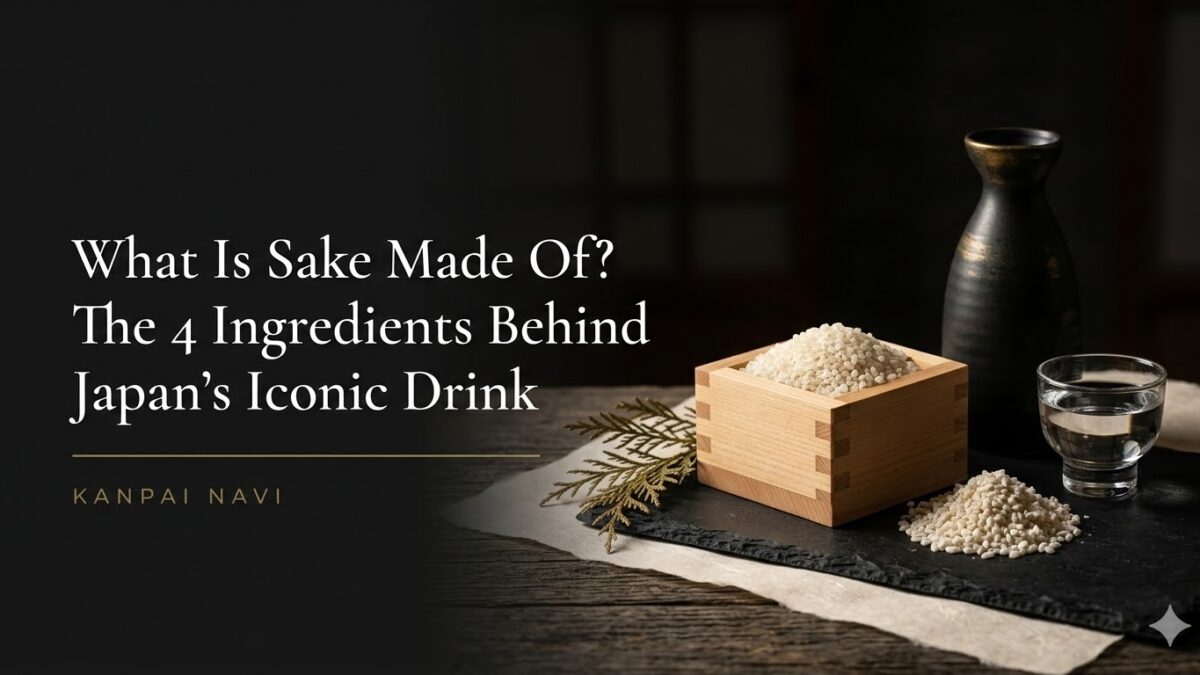
What Is Sake Made Of? The 4 Ingredients Behind Japan’s Iconic Drink
What You’ll Learn in This Article
Sake is one of the world’s simplest alcoholic beverages — on paper. It’s made from just 4 ingredients: rice, water, koji mold, and yeast. No grapes, no hops, no botanicals, no added sugar. Just four elements, combined through a fermentation process so unique that UNESCO recognized it as Intangible Cultural Heritage in 2024.
But “simple ingredients” doesn’t mean simple at all. The type of rice, the mineral profile of the water, the strain of koji, and the variety of yeast all dramatically shape the final product. Two breweries using the same four ingredients can produce sakes that taste nothing alike. Understanding what sake is made of is the first step to understanding why it tastes the way it does.
Supervised by
Daichi Takemoto
Authentic Bartender & Owner of Obanzai Nanchatte, Kobe
With 8 years of experience as a professional bartender and now the owner of "Obanzai Nanchatte" in Kobe, Daichi brings hands-on expertise in Japanese sake, whisky, and food pairing to every article on Kanpai Navi.
Table of Contents
- The 4 Ingredients in Sake
- Sake Rice Is Not Table Rice
- Major Sake Rice Varieties
- Rice Polishing (Seimai)
- Water — 80% of Every Bottle
- Koji — The Secret Ingredient
- What Koji Does
- Koji-Making Is the Most Critical Step
- Yeast — The Flavor Artist
- The Optional Fifth Ingredient: Brewer’s Alcohol
- How These Ingredients Become Sake
- Frequently Asked Questions
- Is sake made from rice?
- Does sake contain gluten?
- Is sake a wine or a beer?
- What is koji mold?
- Why is water so important for sake?
- What is the difference between junmai and non-junmai sake?
- The Bottom Line
The 4 Ingredients in Sake
Every sake on earth — from a $5 table sake to a $500 competition daiginjo — is made from the same four core ingredients:
| Ingredient | Japanese | Role |
|---|---|---|
| Rice | Kome (米) | The starch source — provides the sugars that ferment into alcohol |
| Water | Mizu (水) | Makes up ~80% of finished sake. Mineral content shapes flavor and texture. |
| Koji mold | Koji-kin (麹菌) | Converts rice starch into fermentable sugar — the engine of sake brewing |
| Yeast | Kobo (酵母) | Converts sugar into alcohol and produces aromatic compounds |
Some sake styles also include a fifth ingredient — brewer’s alcohol (jozo alcohol) — added in small amounts to adjust flavor and aroma. Sake made without added alcohol is called junmai (pure rice). Both styles are legitimate and have their own merits.
Let’s examine each ingredient in detail.
Sake Rice Is Not Table Rice
The rice used to brew sake — called sakamai (酒米) or shuzō kōtekimai (酒造好適米) — is fundamentally different from the table rice you eat for dinner. Here’s how:
| Sake Rice (Sakamai) | Table Rice (Uruchimai) | |
|---|---|---|
| Grain size | 25-30% larger | Standard |
| Starch core | Large, concentrated center (shinpaku) | Distributed throughout |
| Protein/fat | Lower | Higher |
| Growing | Taller stalks, harder to cultivate | Shorter, more resilient |
| Cost | 2-4x more expensive | Standard |
| Taste (cooked) | Not great — too starchy, lacks flavor | Delicious |
The most critical feature of sake rice is the shinpaku (心白) — a white, opaque starch core at the center of each grain. This concentrated starch is surrounded by an outer layer of proteins, fats, and minerals. Before brewing, rice is polished (milled) to remove this outer layer, leaving the pure starch core for koji to work with.
Major Sake Rice Varieties
Japan cultivates over 100 varieties of sake rice, but a handful dominate premium production:
- Yamada Nishiki — The undisputed king. Grown primarily in Hyogo prefecture, it produces the most elegant, aromatic sake. Used in the majority of competition-winning daiginjo.
- Gohyakumangoku — The most widely planted sake rice. Produces clean, crisp, dry sake. Popular in Niigata and northern regions.
- Miyama Nishiki — Cold-resistant variety grown in northern Japan. Produces light, refreshing sake with good acidity.
- Omachi — The oldest pure sake rice variety, dating to 1859. Produces rich, full-bodied sake with deep, earthy flavors. A cult favorite.
- Hattannishiki — Hiroshima specialty. Produces soft, well-rounded sake.
The rice variety affects sake the same way grape variety affects wine — Yamada Nishiki sake is to Pinot Noir wine what Omachi sake is to Cabernet Sauvignon.
Rice Polishing (Seimai)
Before brewing, each grain of rice is milled in precision machines to remove the outer layers. The rice polishing ratio (seimai-buai) indicates how much of the original grain remains:
- 70% remaining (30% removed) — standard for junmai and honjozo
- 60% remaining (40% removed) — required for ginjo grade
- 50% remaining (50% removed) — required for daiginjo grade
- Below 50% — ultra-premium. Some competition sakes polish down to 23% or even 1%
More polishing removes more proteins, fats, and off-flavor compounds, producing cleaner, more aromatic sake. But it also removes flavor — which is why some brewers argue that less polishing can produce more interesting, characterful sake.
Daichi Takemoto
The polishing ratio obsession can be misleading. Some of the most interesting sake I’ve tasted are junmai with minimal polishing — 80% or even 90% remaining. They have a rice-forward richness and earthiness that over-polished daiginjo can’t match. More polishing doesn’t always mean better sake — just different sake.
Water — 80% of Every Bottle
Water is the most abundant ingredient in sake — it constitutes roughly 80% of the finished product. The mineral content of brewing water has an enormous impact on the final sake.
Japanese brewing water falls into two broad categories:
| Hard Water (Kōsui) | Soft Water (Nansui) | |
|---|---|---|
| Mineral content | Higher (calcium, magnesium, potassium) | Lower |
| Fermentation | Faster, more vigorous | Slower, gentler |
| Sake character | Bold, dry, full-bodied | Soft, smooth, elegant |
| Famous region | Nada (Kobe) | Fushimi (Kyoto) |
| Classic style name | Otoko-zake (masculine sake) | Onna-zake (feminine sake) |
The two most famous brewing water sources in Japan are:
- Miyamizu (Nada, Kobe) — Hard water that produces bold, dry sake. Hakutsuru, Kiku-Masamune, and other major Nada breweries use this water.
- Gokosui (Fushimi, Kyoto) — Soft water that produces smooth, elegant sake. Gekkeikan and other Fushimi breweries rely on this water.
Beyond minerals, brewing water must be iron-free. Even trace amounts of iron cause sake to turn brown and develop off-flavors — which is why brewery location has historically been determined by water quality.
Koji — The Secret Ingredient
If sake has a secret weapon, it’s koji (麹) — specifically Aspergillus oryzae, a filamentous mold that has been cultivated in East Asia for thousands of years. Koji is so central to Japanese food culture that it was designated Japan’s “national mold” (kokkin) in 2006.
What Koji Does
Rice starch cannot ferment into alcohol on its own — yeast can only consume simple sugars, not complex starches. Koji solves this problem by producing enzymes (amylases) that break down rice starch into fermentable glucose. Without koji, sake couldn’t exist.
In sake brewing, steamed rice is inoculated with koji spores and incubated in a warm, humid room (koji-muro) for about 48 hours. During this time, the mold grows into the rice, producing the enzymes that will convert starch to sugar throughout the fermentation process.
Koji-Making Is the Most Critical Step
Ask any master brewer (toji) which step matters most, and they’ll almost always say koji-making. The quality of the koji determines:
- How efficiently starch converts to sugar
- The amino acid profile (umami content) of the finished sake
- Whether fermentation proceeds smoothly or produces off-flavors
Brewers often sleep in the koji room during this 48-hour process, monitoring temperature and humidity around the clock.
Daichi Takemoto
I visited a brewery in Fushimi during brewing season, and the toji hadn’t slept in 36 hours — he was hand-turning koji rice every few hours. That level of dedication is why craft sake tastes so different from mass-produced bottles. The koji step alone determines whether you get something extraordinary or something ordinary.
Yeast — The Flavor Artist
While koji creates the sugar, yeast (kobo) does two things: converts that sugar into alcohol and produces aromatic compounds (esters and acids) that give sake its distinctive flavors and aromas.
Different yeast strains produce dramatically different sake. The Brewing Society of Japan maintains a library of standardized strains, each producing distinct flavor profiles:
| Yeast Strain | Character | Commonly Used For |
|---|---|---|
| No. 7 | Balanced, reliable. Mild, clean aromas. | Everyday sake, honjozo |
| No. 9 | Fruity, aromatic. Apple and pear esters. | Ginjo, daiginjo |
| No. 14 | Low acidity, delicate. Banana and melon. | Premium ginjo |
| No. 1801 | Highly aromatic. Tropical fruit, floral. | Competition daiginjo |
Many modern craft breweries have also begun isolating wild yeasts from flowers, fruits, or local environments — creating unique, terroir-driven sake that couldn’t exist anywhere else.
The Optional Fifth Ingredient: Brewer’s Alcohol
Some sake includes a small amount of distilled alcohol (jozo alcohol) added during the final stages of fermentation. This isn’t done to increase ABV — the amount is strictly regulated — but to:
- Enhance aroma — alcohol helps extract and preserve volatile aromatic compounds
- Lighten the body — creates a crisper, cleaner mouthfeel
- Stabilize the product — helps prevent off-flavor development
Sake made without added alcohol is called junmai (純米, “pure rice”). Sake with added alcohol includes honjozo, ginjo, and daiginjo (without the “junmai” prefix). Neither style is inherently better — they’re different tools for different flavor goals.
How These Ingredients Become Sake
The brewing process — from raw rice to finished sake — takes roughly 60-90 days. Here’s a simplified overview of how the four ingredients come together:
- Polishing: Brown rice is milled to remove outer layers
- Washing and soaking: Polished rice is cleaned and absorbs water
- Steaming: Rice is steamed (not boiled) to gelatinize starch
- Koji-making: Steamed rice is inoculated with koji mold and incubated for 48 hours
- Yeast starter (shubo): Koji rice, steamed rice, water, and yeast are combined in a small tank. Dense yeast population develops over 2-4 weeks
- Main fermentation (moromi): The yeast starter is scaled up with additions of steamed rice, koji, and water over 4 days. Multiple Parallel Fermentation begins — koji converts starch to sugar while yeast simultaneously converts sugar to alcohol
- Pressing: After 18-32 days, the fermented mash is pressed to separate clear sake from rice solids
- Filtration, pasteurization, and aging: The sake is refined and rested before bottling
The magic happens in step 6 — Multiple Parallel Fermentation. This process, unique to sake, is why it can reach 18-20% ABV naturally without distillation, higher than any grape wine. It’s also what gives sake its extraordinary range of flavors from just four ingredients.
Daichi Takemoto
What amazes me about sake is that four ingredients — rice, water, mold, and yeast — can produce flavors ranging from tropical fruit to dark chocolate to fresh cream. Wine has the grape variety to lean on. Beer has hops and malt. Sake does it all with rice and craftsmanship alone.
Frequently Asked Questions
Here are the most common questions about sake ingredients.
Is sake made from rice?
Yes. Sake is made from rice, water, koji mold (Aspergillus oryzae), and yeast. The rice used is a special variety called sakamai, which has a larger grain and a concentrated starch core compared to regular table rice.
Does sake contain gluten?
No. Sake is made entirely from rice, water, koji, and yeast — none of which contain gluten. It is considered safe for people with celiac disease or gluten sensitivity.
Is sake a wine or a beer?
Technically, sake’s production process is closer to beer (converting starch to sugar before fermentation) than wine (fermenting fruit sugar directly). However, sake’s alcohol content (14-20%) and serving style are closer to wine. In practice, it’s in a category of its own.
What is koji mold?
Koji (Aspergillus oryzae) is a filamentous mold used in Japanese food production for thousands of years. It produces enzymes that convert starch into fermentable sugar — an essential step in making sake, miso, soy sauce, and mirin. It was designated Japan’s “national mold” in 2006.
Why is water so important for sake?
Water makes up about 80% of finished sake, so its mineral content directly affects flavor. Hard water (like Nada’s Miyamizu) produces bold, dry sake. Soft water (like Fushimi’s Gokosui) produces smooth, elegant sake. Water must also be iron-free, as even trace iron causes discoloration and off-flavors.
What is the difference between junmai and non-junmai sake?
Junmai sake is made with only rice, water, koji, and yeast — no added alcohol. Non-junmai styles (honjozo, ginjo, daiginjo without the “junmai” prefix) include a small amount of distilled alcohol added to enhance aroma and lighten the body. Both are legitimate sake styles with different flavor profiles.
The Bottom Line
Sake’s beauty lies in its simplicity — just rice, water, koji, and yeast. But within that simplicity is extraordinary depth. The variety of rice, the mineral profile of the water, the precision of koji cultivation, and the choice of yeast strain all combine to create a beverage with a flavor range rivaling any wine. Understanding these four ingredients is the key to understanding why one sake tastes completely different from another — and why this ancient craft earned its place on UNESCO’s cultural heritage list.