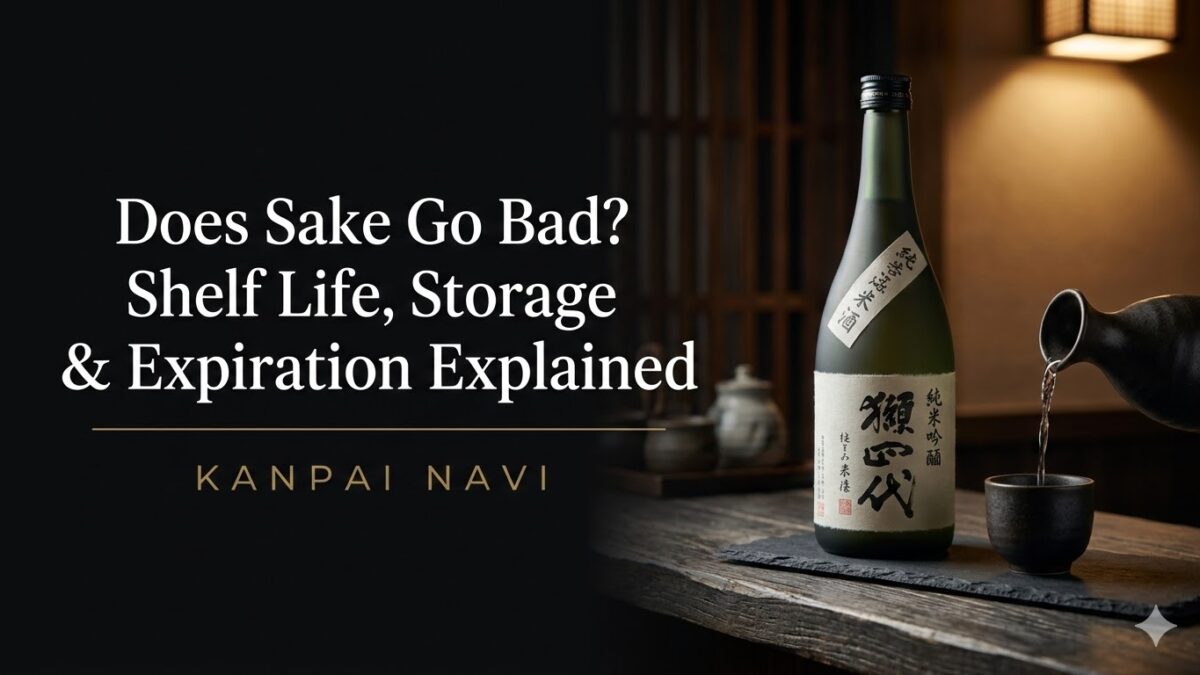
Does Sake Go Bad? Shelf Life, Storage & Expiration Explained
What You’ll Learn in This Article
You found a bottle of sake in the back of your pantry. Maybe it’s been there six months, maybe two years. The cap’s still sealed, the liquid looks fine, and you’re wondering: is this still drinkable, or should it go down the drain?
This is one of the most common questions in sake — and most articles give you a vague “it depends” before listing some general guidelines. Here’s what actually happens inside that bottle, why different sake types degrade at dramatically different rates, and how to tell in thirty seconds whether your sake is still worth drinking.
The short answer: sake never becomes dangerous to drink, but it absolutely becomes unpleasant. Unlike spirits (which are shelf-stable essentially forever) or wine (which sometimes improves with age), most sake is a perishable product designed to be consumed fresh. The chemistry of deterioration is well understood, predictable, and — with proper storage — largely preventable.
Supervised by
Daichi Takemoto
Authentic Bartender & Owner of Obanzai Nanchatte, Kobe
With 8 years of experience as a professional bartender and now the owner of "Obanzai Nanchatte" in Kobe, Daichi brings hands-on expertise in Japanese sake, whisky, and food pairing to every article on Kanpai Navi.
Table of Contents
- Does Sake Go Bad?
- The Three Enemies of Sake
- Enemy 1: Heat
- Enemy 2: Light
- Enemy 3: Air (Oxygen)
- Shelf Life by Sake Type
- The Bartender’s 30-Second Freshness Test
- Step 1: Look (5 seconds)
- Step 2: Smell (10 seconds)
- Step 3: Taste (15 seconds)
- How to Store Sake Properly
- Unopened Sake
- Opened Sake
- What to Do with Sake That’s Past Its Prime
- The Koshu Exception: When “Old” Means “Better”
- Frequently Asked Questions
- Does sake expire?
- Can old sake make you sick?
- How long does sake last after opening?
- Should sake be refrigerated?
- Can sake be aged like wine?
- What does the date on a sake bottle mean?
- The Bottom Line
Does Sake Go Bad?
Sake occupies an unusual middle ground in the alcohol world. It has enough alcohol (14-17% ABV) to prevent dangerous bacterial growth — you will never get food poisoning from old sake, no matter how long it’s been sitting. But unlike 40% ABV spirits, sake’s moderate alcohol content doesn’t prevent chemical degradation. The flavor compounds that make sake delicious — fruity esters, clean amino acids, delicate aromatic compounds — are inherently unstable. They break down over time, and what replaces them is decidedly less appealing.
Here’s what happens inside a bottle of sake as it ages past its prime:
Oxidation. Oxygen reacts with the sake’s amino acids and sugars, producing melanoidins — brown-colored compounds that darken the sake from clear to yellow to amber. These same reactions create off-flavors described as “cardboard,” “wet paper,” or “stale bread.” Oxidation is the primary enemy of opened sake, and it begins the moment you break the seal.
Maillard reactions. The same chemical process that browns bread and develops coffee flavors slowly occurs in sake at room temperature. Amino acids react with residual sugars, producing caramel and toffee notes that can be pleasant in small amounts (this is how koshu/aged sake develops its character) but become heavy and cloying in sake that wasn’t designed for aging.
Ester degradation. The volatile esters that produce ginjo-ka — those melon, pear, apple, and floral aromas that define premium sake — are the most fragile compounds in the bottle. They evaporate, decompose, and recombine over time. A daiginjo that smelled like a perfumed orchard six months ago may smell like nothing at all today. This is why premium aromatic sakes have the shortest shelf life of any sake type.
The Three Enemies of Sake
Every sake deterioration pathway is accelerated by three environmental factors. Understanding these isn’t just academic — it directly tells you how to store sake for maximum freshness.
Enemy 1: Heat
Temperature is the single most important variable in sake preservation. Chemical reaction rates roughly double for every 10°C increase in temperature. A bottle stored at 25°C (room temperature) degrades approximately four times faster than one stored at 5°C (refrigerator temperature).
This means a junmai stored in your kitchen at room temperature for three months has degraded as much as one stored in the refrigerator for a year. The math is stark: refrigeration doesn’t just slow degradation — it functionally quadruples the shelf life of every sake type.
The worst scenario is temperature cycling — moving a bottle between warm and cool environments repeatedly. Each warming accelerates chemical reactions, and the accumulated damage is greater than constant storage at either temperature. If your sake has been riding in a hot car trunk, sitting in a sunny window, or traveling between a warm shelf and the refrigerator repeatedly, it’s degraded faster than the guidelines suggest.
Enemy 2: Light
UV radiation causes a specific and well-documented defect in sake called nikko-shu (日光臭) — literally “sunlight smell.” UV light triggers the breakdown of riboflavin (vitamin B2) and certain amino acids, producing dimethyl disulfide and other sulfur compounds. The result is an unpleasant odor variously described as “burnt rubber,” “cooked corn,” or “skunky” — similar to the light-strike defect in beer.
This reaction happens surprisingly fast. Direct sunlight can produce detectable nikko-shu in as little as 3-4 hours. Even fluorescent store lighting causes gradual damage over days and weeks. This is why premium sake bottles are often dark green or brown — the colored glass filters UV. Clear glass bottles (common for ginjo and daiginjo) offer no UV protection at all.
Practical implication: Never store sake on a countertop, windowsill, or open shelf that receives any sunlight. Dark storage — a closet, a cabinet, or ideally a refrigerator — is essential.
Enemy 3: Air (Oxygen)
Oxygen drives oxidation — the primary chemical process that degrades opened sake. The moment you break the seal, atmospheric oxygen begins reacting with the sake’s amino acids and phenolic compounds. The rate depends on how much oxygen is in contact with the sake, which is determined by two factors: how tightly you reseal the bottle and how much headspace (empty air) is above the liquid.
A half-empty bottle oxidizes faster than a nearly full one because there’s more oxygen in contact with the sake’s surface. This is why the last glass from a bottle that’s been open for two weeks tastes noticeably worse than the first glass — it’s had the most oxygen exposure.
Daichi Takemoto
The biggest mistake I see: people treat sake like whisky — leaving it on a shelf for months after opening. Whisky is 40% alcohol; it barely changes. Sake is 15% — it’s closer to wine. I tell my guests: if you open a bottle of ginjo, plan to finish it within a week. If you can’t, pour the remainder into a smaller container to minimize headspace, seal it tight, and refrigerate. That buys you another few days.
Shelf Life by Sake Type
Different sake types degrade at dramatically different rates because they contain different concentrations of the vulnerable compounds. Here’s a detailed breakdown with the reasoning behind each timeline.
| Sake Type | Unopened (Refrigerated) | Unopened (Room Temp) | Opened (Refrigerated) | Why |
|---|---|---|---|---|
| Futsu-shu (table sake) | 12+ months | 6-9 months | 1-2 weeks | Robust, few delicate compounds to lose |
| Junmai | 12 months | 6-9 months | 1-2 weeks | Higher amino acids buffer against degradation |
| Honjozo | 12 months | 6-9 months | 1-2 weeks | Added alcohol provides slight stabilization |
| Ginjo / Junmai Ginjo | 8-10 months | 4-6 months | 3-7 days | Delicate ginjo-ka esters degrade quickly |
| Daiginjo / Junmai Daiginjo | 6-10 months | 3-6 months | 3-5 days | Most volatile aromatics, most temperature-sensitive |
| Nama (unpasteurized) | 4-6 months (must refrigerate) | Not recommended | 2-3 days | Active enzymes continue altering flavor |
| Sparkling sake | 6-8 months | Not recommended | 1-2 days | Carbonation escapes rapidly after opening |
| Koshu (aged sake) | Years to decades | Years (controlled conditions) | 2-4 weeks | Designed for Maillard reactions; already oxidized |
Critical note on nama sake: Nama (unpasteurized) sake is the most perishable. Unlike pasteurized sake, nama still contains active enzymes (amylase and protease from the koji) that continue breaking down starches and proteins in the bottle. Without refrigeration, these reactions accelerate rapidly, changing the sake’s flavor profile within days. Some nama develops pleasant new characteristics (“nama-hine”), but most simply becomes muddled and off-balance. Treat nama like fresh milk: always refrigerate, never leave out.
The Bartender’s 30-Second Freshness Test
You don’t need laboratory equipment to assess whether sake is still worth drinking. This is the method professional bartenders use to evaluate bottles — a systematic sensory check that takes thirty seconds and catches every common form of deterioration.
Step 1: Look (5 seconds)
Hold the bottle or glass up to a white background or light source. Fresh sake should be crystal clear (unless it’s nigori) with little to no color — water-clear to the faintest pale yellow.
- Noticeably yellow: Early oxidation. The sake is past peak but may still be drinkable — taste it. Common in sake that’s been stored at room temperature for several months.
- Amber or brown: Advanced oxidation and Maillard reactions. The sake will taste heavy, caramelized, and stale. Use for cooking.
- Cloudy (in clear sake): Possible bacterial contamination or protein haze. Unusual in pasteurized sake — taste cautiously.
Step 2: Smell (10 seconds)
Pour a small amount and bring it to your nose. This is where most defects reveal themselves clearly.
- No aroma at all: If it’s a ginjo or daiginjo, the ginjo-ka has degraded. The sake is still safe but has lost its defining character. Consider warming it — heat can bring out residual flavors.
- Musty, papery smell: Oxidation. The “wet cardboard” note is the classic sign of a sake past its prime.
- Burnt rubber or skunky: Light damage (nikko-shu). The bottle was exposed to UV radiation.
- Sharp vinegar: Bacterial acetic acid production. Rare in pasteurized sake, more common in nama. Use for cooking or discard.
- Fresh fruit, rice, clean: The sake is fine. Drink it.
Step 3: Taste (15 seconds)
Take a small sip if the appearance and smell passed. Focus on:
- Flat, dull flavor with no finish: The sake has faded. Not spoiled, just past its best. Use for cooking or drink warm — warming can temporarily revive some body and flavor.
- Harsh bitterness in the finish: Oxidation has produced phenolic compounds. The sake is past its useful drinking life.
- Heavy, cloying sweetness: Maillard reactions have shifted the balance. Use for cooking.
- Clean, balanced, refreshing: The sake is still good. Enjoy it.
Daichi Takemoto
At my bar, I do this check every time I open a bottle — even freshly delivered ones. Occasionally a bottle has been stored poorly somewhere in the supply chain. Takes thirty seconds and saves me from serving a bad glass. The nose is your best tool — if it smells off, it tastes off. If it smells clean, it almost always is. Trust your nose before anything else.
How to Store Sake Properly
Proper storage is the difference between sake that’s still excellent after six months and sake that’s past its prime after six weeks. The rules are simple, but following all of them consistently makes an enormous difference.
Unopened Sake
Refrigerate everything. Yes, even futsu-shu and junmai. Refrigeration (3-5°C) slows every degradation reaction by a factor of roughly four. If you have limited fridge space, prioritize in this order: nama (mandatory), ginjo/daiginjo (very important), sparkling (very important), junmai/honjozo (important), futsu-shu (beneficial but least critical).
Store upright. Unlike wine, sake has no cork that needs to stay moist. Upright storage minimizes the surface area exposed to air in the bottle and prevents the liquid from contacting the cap, which can sometimes impart off-flavors over long periods.
Keep in complete darkness. No windowsills, no open shelves, no display cases with lighting. The refrigerator is ideal because it’s both cold and dark. If you store sake outside the fridge, use a closed cabinet or box.
Avoid temperature fluctuation. Consistent temperature matters more than absolute temperature. A sake stored consistently at 15°C will be in better condition than one that alternates between 5°C and 25°C as you move it in and out of the fridge. Decide where a bottle lives and leave it there until you’re ready to drink.
Opened Sake
Refrigerate immediately after every pour. Don’t leave an opened bottle on the dinner table for the entire evening — pour what you need, reseal, and return to the fridge. The cumulative warmth and air exposure during a multi-hour dinner can degrade a premium ginjo noticeably.
Minimize headspace. As you drink through a bottle, the increasing air space accelerates oxidation. When a bottle is half-empty, consider transferring the remaining sake to a smaller, clean container (a 300ml bottle or mason jar) and sealing it tightly. This removes the excess air and dramatically slows oxidation.
Use a proper seal. If the original cap doesn’t seal well, use a wine stopper or vacuum pump. A loose cap is almost as bad as no cap — it allows continuous oxygen exchange.
What to Do with Sake That’s Past Its Prime
Old sake isn’t waste — it’s a cooking ingredient. The same compounds that taste “off” when drinking become assets when cooking.
- Marinades: Sake tenderizes proteins and adds umami depth. Old sake works perfectly here — the subtleties you’d want in a drinking sake are irrelevant in a marinade.
- Deglazing: Use old sake to deglaze a pan after searing fish or meat. The alcohol evaporates, leaving behind umami and sweetness.
- Steaming liquid: Add sake to the water when steaming shellfish, vegetables, or dumplings. The residual amino acids enhance the food’s natural flavors.
- Rice cooking: A tablespoon of sake in your rice cooker water adds subtle flavor and improves the texture of steamed rice — a classic Japanese kitchen technique.
- Hot pot and soup base: Add old sake to nabe (hot pot), miso soup, or ramen broth for an umami boost. No one will detect the oxidation once it’s part of a complex broth.
The Koshu Exception: When “Old” Means “Better”
Everything above applies to standard sake — but there’s one category that turns these rules upside down. Koshu (古酒) is sake intentionally aged for years or decades under controlled conditions. The oxidation and Maillard reactions that ruin regular sake are precisely what koshu brewers want — they produce the amber color, caramel sweetness, and sherry-like complexity that define the style.
Koshu isn’t “sake that went bad slowly.” It’s sake specifically selected and stored for aging — typically robust junmai styles with high amino acid content that provides raw material for flavor-developing reactions. The aging happens at controlled temperatures (often cellar conditions around 10-15°C), and the brewer monitors the process to guide the development.
If you discover an old bottle of standard sake and it’s turned amber with caramel notes, that’s not koshu — that’s deteriorated sake that’s had an accidental partial version of the koshu process. It might be interesting to taste, but it won’t have the complexity of deliberately aged koshu.
Frequently Asked Questions
Does sake expire?
Sake has no expiration date. Japanese labels show a manufacturing date (製造年月, seizou nengetsu) — the bottling date, not an expiration date. Sake doesn’t become unsafe after any particular date, but its quality declines progressively. Most sake is best consumed within 6-12 months of bottling, with premium ginjo/daiginjo styles best within 6-8 months.
Can old sake make you sick?
No. Sake’s alcohol content (14-17% ABV) prevents the growth of harmful bacteria. Old sake tastes bad — oxidized, flat, sometimes bitter — but it’s safe to consume. If your sake smells or tastes off, it’s a quality issue, not a safety issue.
How long does sake last after opening?
Refrigerated: futsu-shu and junmai last 1-2 weeks; ginjo and daiginjo last 3-7 days; nama lasts 2-3 days; sparkling lasts 1-2 days. These timelines assume proper refrigeration and a tight seal. At room temperature, all of these windows shrink dramatically.
Should sake be refrigerated?
Yes — always. Refrigeration is the single most effective way to preserve sake quality, slowing chemical degradation by roughly 4x compared to room temperature. Opened sake must always be refrigerated. Unopened sake benefits significantly from refrigeration, especially ginjo, daiginjo, and nama styles.
Can sake be aged like wine?
Most sake should be consumed fresh — it’s designed to be at its best shortly after bottling. Koshu (aged sake) is the deliberate exception, where specific sake types are aged under controlled conditions to develop complex, sherry-like characteristics. Unless a bottle is specifically labeled as koshu or intended for aging, drink it fresh.
What does the date on a sake bottle mean?
The date on Japanese sake labels is the manufacturing date (製造年月) — when the sake was bottled, not when it was brewed. Sake is sometimes brewed months before bottling, so the bottling date is more useful for assessing freshness. Use this date as your starting point for the shelf life guidelines above.
The Bottom Line
Sake doesn’t go bad in a way that’s dangerous, but it absolutely goes bad in a way that matters. The three enemies — heat, light, and oxygen — drive chemical reactions that strip away everything that makes sake worth drinking: the aromatic complexity, the clean flavor, the refreshing balance. The defense is simple and effective: refrigerate everything, keep it dark, finish opened bottles quickly, and use the 30-second freshness test when you’re unsure. If your sake has turned yellow and lost its aroma, don’t pour it out — use it for cooking, where those same degradation compounds become useful flavor enhancers. And if you want sake that ages gracefully, buy koshu — sake that was designed for the journey rather than forced into it.


