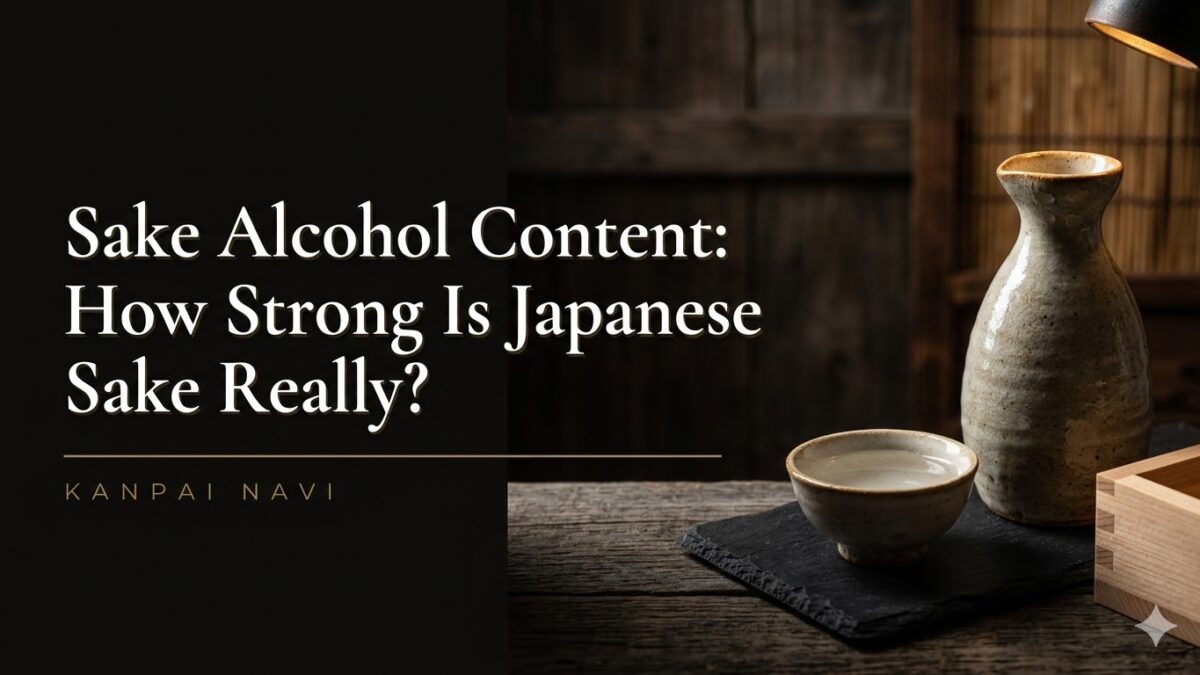
Sake Alcohol Content: How Strong Is Japanese Sake Really?
What You’ll Learn in This Article
- The standard alcohol content of sake — and why it consistently sits at the top of the brewed beverage range
- A detailed ABV comparison against beer, wine, spirits, and other Asian beverages
- Why sake’s multiple parallel fermentation makes it the strongest non-distilled beverage in the world
- ABV breakdown by type — from 5% sparkling sake to 19% undiluted genshu
- How to calculate standard drinks from sake and pace yourself properly
Sake occupies an unusual position on the alcohol spectrum. It is brewed from grain like beer but reaches alcohol levels that match or exceed wine. Most people trying sake for the first time are caught off guard by how strong it actually is — partly because it goes down so smoothly, and partly because the small serving vessels make it easy to lose track of volume.
This guide covers everything you need to know about sake alcohol content: exact ABV ranges for every style, honest comparisons with other drinks, the science behind why sake ferments to such high levels, and practical advice for pacing yourself. Whether you are new to drinking sake or already exploring different sake types, the numbers in this article will change how you approach every pour.
Supervised by
Daichi Takemoto
Authentic Bartender & Owner of Obanzai Nanchatte, Kobe
With 8 years of experience as a professional bartender and now the owner of “Obanzai Nanchatte” in Kobe, Daichi brings hands-on expertise in sake service, ABV-aware portioning, and helping guests navigate alcohol content across every sake category to every article on Kanpai Navi.
Table of Contents
- How Strong Is Sake? The Short Answer
- Japan’s Legal ABV Ceiling
- Sake vs Wine vs Beer vs Spirits: The Complete ABV Comparison
- Sake vs Wine
- Sake vs Beer
- Sake vs Spirits and Asian Beverages
- Why Sake Reaches Higher ABV Than Wine: The Science of Parallel Fermentation
- How Wine Fermentation Works (Single-Step)
- How Sake Fermentation Works (Multiple Parallel)
- Water Addition: Why Most Sake Is Diluted After Brewing
- Genshu: The Exception That Proves the Rule
- ABV by Sake Type: A Complete Breakdown
- Junmai (Pure Rice Sake): 14-16% ABV
- Ginjo and Daiginjo: 13-16% ABV
- Honjozo: 13-15% ABV
- Futsushu (Table Sake): 13-16% ABV
- Sparkling and Low-Alcohol Sake: 5-8% ABV
- Standard Drinks, Serving Sizes, and How to Pace Yourself
- What Is a Standard Drink?
- Serving Vessel Math
- Practical Pacing Strategies
- Factors That Influence Sake’s Final ABV
- Yeast Strain
- Fermentation Temperature
- Rice Polishing Ratio
- Koji Activity and Mash Concentration
- Common Myths About Sake Alcohol Content
- Myth: “Sake Is a Spirit”
- Myth: “Sake Doesn’t Cause Hangovers”
- Myth: “Higher-Quality Sake Has Higher ABV”
- Myth: “Genshu Is Always the Strongest Sake”
- Frequently Asked Questions
- Is sake stronger than wine?
- Can sake get you drunk?
- What is the strongest type of sake?
- Is sake a spirit, a wine, or a beer?
- Why does sake seem to cause fewer hangovers than wine?
- Does heating sake change its alcohol content?
- The Bottom Line
- Sources & References
How Strong Is Sake? The Short Answer
Most sake falls between 13% and 16% ABV. That places it firmly in wine territory — well above beer, but far below spirits. The exact alcohol content depends on the style, the brewing method, and whether the brewer added water after fermentation.
A standard bottle of sake from any reputable producer — whether junmai, ginjo, or daiginjo — will almost always land within this 13-16% window. Specialty styles push that range in both directions: genshu (undiluted sake) reaches 17-19%, while sparkling sake and low-alcohol varieties can dip as low as 5%.
The critical number most drinkers miss is the pre-dilution ABV. Before brewers add water, the fermentation mash naturally reaches 18-20% ABV — making sake the strongest traditionally brewed (non-distilled) beverage in the world. Water addition after brewing is what brings most bottles back down to their labeled 15-16%.
Japan’s Legal ABV Ceiling
Under Japan’s Liquor Tax Act, sake must remain at or below 22% ABV to be classified as seishu (the legal term for sake). Anything above that threshold is reclassified as a liqueur and taxed differently. In practice, no standard sake approaches that ceiling — even undiluted genshu typically tops out around 19%.
This legal framework matters because it shapes what brewers produce. The 22% cap is generous enough that it never constrains brewing decisions. Instead, it simply draws a clear line between brewed sake and distilled spirits like shochu (typically 25% ABV) and whisky (40%+).
| Sake Category | Typical ABV Range | How ABV Is Achieved |
|---|---|---|
| Junmai | 14-16% | Full fermentation + water addition |
| Ginjo / Daiginjo | 13-16% | Controlled fermentation + water addition |
| Honjozo | 13-15% | Brewer’s alcohol addition + water addition |
| Genshu (undiluted) | 17-19% | Full fermentation, no water addition |
| Low-ABV genshu | 14-15% | Managed fermentation, no water addition |
| Sparkling sake | 5-8% | Early bottling or dilution |
| Low-alcohol sake | 5-7% | Arrested fermentation or heavy dilution |
Sake vs Wine vs Beer vs Spirits: The Complete ABV Comparison
The most common question about sake’s strength is how it stacks up against other drinks. The answer depends on which drinks you are comparing — and the details matter more than most people realize.
Sake vs Wine
On paper, sake and wine look nearly identical. Both cluster in the 13-16% ABV range for standard bottles. But sake consistently sits at the higher end of that range. A typical red wine comes in at 13-14%. A typical junmai sake lands at 15-16%. That 1-2 percentage point gap adds up over the course of an evening.
The difference becomes dramatic with genshu. Undiluted sake at 17-19% ABV is stronger than virtually every table wine on the market. Only fortified wines like port (19-22%) and sherry (15-22%) match or exceed genshu — and those are fortified with added spirits, not naturally fermented to that level.
| Wine Type | Typical ABV | Comparable Sake Type | Sake ABV |
|---|---|---|---|
| Prosecco | 11-12% | Sparkling sake (premium) | 10-13% |
| Pinot Grigio | 12-13% | Junmai ginjo | 13-15% |
| Chardonnay | 13-14.5% | Junmai | 14-16% |
| Cabernet Sauvignon | 13.5-15% | Junmai (full-body) | 15-16% |
| Amarone | 15-16% | Genshu | 17-19% |
| Port (fortified) | 19-22% | No equivalent | — |
Sake vs Beer
This is where the gap becomes stark. Standard beer sits at 4-6% ABV. Standard sake is three times stronger. Even a strong craft IPA at 7-8% is still roughly half the alcohol content of a typical junmai sake.
The comparison matters because many people encounter sake in Japanese restaurants where they may also be drinking beer. Switching from a 5% beer to a 15% sake without adjusting your pace is a reliable path to overindulgence. One 180ml tokkuri of sake at 15% contains the same alcohol as roughly three standard beers.
Sake vs Spirits and Asian Beverages
Sake is nowhere near spirits territory. Whisky, vodka, gin, and rum all start at 40% ABV — roughly three times stronger than standard sake. This is because spirits are distilled, which concentrates alcohol far beyond what fermentation alone can produce.
Among Asian beverages, sake occupies a middle ground. Chinese huangjiu (yellow wine) is similar at 14-20% ABV. Korean makgeolli is lower at 6-8%. Shochu, Japan’s other major traditional alcohol, is distilled and typically comes in at 25% ABV.
| Beverage | Origin | Type | Typical ABV |
|---|---|---|---|
| Light beer | Various | Brewed | 3-4% |
| Standard beer / lager | Various | Brewed | 4-6% |
| Craft IPA | Various | Brewed | 6-8% |
| Makgeolli | Korea | Brewed | 6-8% |
| Sparkling sake | Japan | Brewed | 5-8% |
| Wine | Various | Fermented | 11-15% |
| Sake (standard) | Japan | Brewed | 13-16% |
| Genshu (undiluted sake) | Japan | Brewed | 17-19% |
| Huangjiu (yellow wine) | China | Brewed | 14-20% |
| Shochu | Japan | Distilled | 25% |
| Soju | Korea | Distilled | 16-25% |
| Whisky / Vodka / Gin | Various | Distilled | 40%+ |
Why Sake Reaches Higher ABV Than Wine: The Science of Parallel Fermentation
Sake’s alcohol content is not an accident or a stylistic choice. It is a direct consequence of the brewing process — specifically, a fermentation mechanism called multiple parallel fermentation. This process is unique to sake and is the reason it naturally reaches higher ABV than any other brewed beverage.
How Wine Fermentation Works (Single-Step)
Wine fermentation is straightforward. Grapes contain sugar. Yeast consumes that sugar and produces alcohol and CO2 as byproducts. When the sugar runs out — or when the rising alcohol level becomes toxic to the yeast and kills it — fermentation stops. Most wine yeast strains die at 14-16% ABV, which sets a natural ceiling on wine’s alcohol content.
This is a single-step process: sugar exists in the fruit, yeast converts it, fermentation ends. The sugar supply is finite and available all at once. Yeast works through it in a burst, and the whole process is over relatively quickly.
How Sake Fermentation Works (Multiple Parallel)
Rice contains no sugar. It contains starch — long chains of glucose molecules that yeast cannot directly metabolize. Before fermentation can happen, the starch must be broken down into fermentable sugar. In sake brewing, this conversion and the fermentation happen simultaneously in the same vessel.
Here is the sequence, all occurring in parallel:
| Step | Agent | Input | Output |
|---|---|---|---|
| 1. Saccharification | Koji mold (Aspergillus oryzae) | Rice starch | Glucose (sugar) |
| 2. Fermentation | Sake yeast (Saccharomyces cerevisiae) | Glucose | Alcohol + CO2 |
The critical insight is that koji releases sugar gradually and continuously — not all at once. This slow-drip sugar supply means the yeast never encounters a massive sugar spike that would trigger osmotic stress. Instead, the yeast receives a steady, manageable stream of glucose. The alcohol concentration rises slowly enough that the yeast can acclimatize, allowing it to survive and continue fermenting at alcohol levels that would kill wine yeast.
The result is a fermentation mash (moromi) that can reach 18-20% ABV — and in some cases, even higher. No other non-distilled fermentation process in the world achieves this. To understand the full ingredient breakdown, see our guide on what sake is made of.
Daichi Takemoto
I explain parallel fermentation to customers using a relay race analogy. In wine, one runner (yeast) sprints until they collapse. In sake, there are two runners (koji and yeast) working in tandem — one keeps handing off fresh energy (sugar) to the other. The second runner never hits a wall because the supply never stops. That’s why sake yeast can push past the point where wine yeast dies. It’s the most elegant fermentation system in the world.
Water Addition: Why Most Sake Is Diluted After Brewing
If sake fermentation naturally hits 18-20% ABV, why do most bottles say 15-16%? The answer is water addition (warimizu). After fermentation and pressing are complete, most brewers add pure water to bring the alcohol content down to a balanced 15-16%.
This is not a cost-cutting measure. Dilution serves three important purposes:
First, it improves drinkability. Sake at 18-20% ABV is intensely concentrated — the flavors can be overpowering and the alcohol burn harsh. Bringing it down to 15-16% opens up the aroma profile and smooths the palate.
Second, it creates balance. Sake flavor is a delicate interplay of sweetness, acidity, umami, and bitterness. At full fermentation strength, the alcohol dominates everything else. Dilution allows the subtler flavors to emerge.
Third, it standardizes the product. Fermentation ABV varies batch to batch. Water addition lets brewers hit a consistent target so that every bottle of a given brand tastes the same, year after year.
Genshu: The Exception That Proves the Rule
Genshu is sake that skips the water addition step entirely. The word literally means “original sake” — the liquid as it came out of fermentation and pressing, with no dilution. Traditional genshu retains the full 17-19% ABV of the fermentation mash.
However, not all genshu is high-alcohol. Some brewers intentionally manage fermentation temperatures and yeast strains to produce a lower-ABV mash — resulting in genshu at 14-15% that was never diluted. The genshu label only means “no water added.” It does not guarantee a specific alcohol level. Always check the label for the actual ABV.
ABV Can Catch You Off Guard
Sake’s smooth texture and mild flavor mask its strength. A standard 180ml tokkuri of sake at 15% ABV contains 2.1 standard drinks — roughly the same as two 150ml glasses of wine at 12%. Genshu at 18% in the same vessel contains 2.6 standard drinks. Because sake is traditionally poured into small cups (ochoko) that hold only 30-45ml, you may not realize how many refills it takes to finish a tokkuri. Count your pours, not your cups. If you feel the effects faster than expected, slow down and add water between servings. For more on sake nutrition and calories, see our dedicated guide.
ABV by Sake Type: A Complete Breakdown
Not all sake is created equal when it comes to alcohol content. The style, rice polishing ratio, yeast strain, fermentation temperature, and dilution strategy all influence the final ABV. Here is a detailed breakdown of every major category.
Junmai (Pure Rice Sake): 14-16% ABV
Junmai is sake brewed with only rice, water, koji, and yeast — no added brewer’s alcohol. It tends to produce a full-bodied, rice-forward flavor profile with rich umami character. Junmai sits at the higher end of the standard ABV range, typically 15-16%, because its full-rice composition supports robust fermentation.
Junmai’s higher ABV pairs well with its bold flavor. The alcohol provides structure and backbone to the dense umami and earthy notes. Lower-ABV junmai exists but is less common — most brewers find that 15-16% is the sweet spot for this style.
Ginjo and Daiginjo: 13-16% ABV
Ginjo (minimum 40% rice polishing) and daiginjo (minimum 50% polishing) are brewed at lower fermentation temperatures over a longer period. This slower, colder fermentation produces more delicate aromatics — the signature fruit and floral notes that define the ginjo style — but also tends to yield slightly lower ABV than junmai in some cases.
The ABV range for ginjo and daiginjo is broader (13-16%) because brewers have more variables to play with. A competition daiginjo might be dialed down to 13-14% to maximize aromatic elegance, while a robust junmai ginjo might sit at 15-16% for fuller body.
Honjozo: 13-15% ABV
Honjozo is sake with a small amount of brewer’s alcohol (jozo alcohol) added during the pressing stage. This addition lightens the body and lifts aromatic compounds into the final sake. Honjozo typically comes in at 13-15% ABV — slightly lower than junmai, reflecting its lighter, cleaner profile.
The added alcohol in honjozo is not about boosting strength. It is a technique for extracting specific flavors and aromas from the mash. The total amount added is strictly regulated and cannot exceed 10% of the rice weight used in brewing.
Futsushu (Table Sake): 13-16% ABV
Futsushu is everyday table sake — the category that accounts for roughly 60-70% of all sake produced in Japan. It has no minimum rice polishing requirement and allows more liberal use of brewer’s alcohol and other additives. ABV typically falls in the same 13-16% range as premium categories.
Despite its “ordinary” classification, futsushu is what most Japanese people drink on a daily basis. The ABV is consistent with premium sake — the difference lies in flavor complexity and ingredient quality, not alcohol content.
| Sake Type | ABV Range | Rice Polishing | Body | Key Feature |
|---|---|---|---|---|
| Junmai | 14-16% | No minimum | Full | Pure rice, rich umami |
| Junmai Ginjo | 13-16% | 60% or less | Medium | Aromatic, balanced |
| Junmai Daiginjo | 13-16% | 50% or less | Light-medium | Elegant, refined |
| Honjozo | 13-15% | 70% or less | Light | Clean, lifted aromas |
| Futsushu | 13-16% | No minimum | Varies | Everyday drinking |
| Genshu | 17-19% | Varies | Full-bold | Undiluted, concentrated |
| Low-ABV genshu | 14-15% | Varies | Medium | Managed fermentation |
| Sparkling sake | 5-8% | Varies | Light | Carbonated, refreshing |
| Low-alcohol sake | 5-7% | Varies | Very light | Gentle, approachable |
Sparkling and Low-Alcohol Sake: 5-8% ABV
At the opposite end of the spectrum, sparkling sake and low-alcohol varieties offer a much lighter drinking experience. Sparkling sake typically ranges from 5-8% ABV, placing it closer to beer or hard seltzer in strength. These styles have grown enormously in popularity, particularly among younger drinkers and international markets.
Low-alcohol sake is produced through several methods: arresting fermentation early (stopping yeast activity before it converts all available sugar), heavy dilution with water, or using specialized yeast strains that produce less alcohol. The result is a beverage that retains sake’s characteristic rice flavor and umami but with a gentler, more sessionable alcohol level.
Standard Drinks, Serving Sizes, and How to Pace Yourself
Understanding ABV in the abstract is one thing. Knowing exactly how much alcohol is in the vessel sitting in front of you is another. This section translates sake ABV into practical numbers you can use at the table.
What Is a Standard Drink?
A “standard drink” contains approximately 10 grams of pure alcohol (the international standard used in most countries outside the US; the US standard is 14 grams). This measurement allows you to compare alcohol intake across different beverages regardless of volume or ABV.
| Beverage | Typical Serving | ABV | Standard Drinks (10g) |
|---|---|---|---|
| Beer | 350ml can | 5% | 1.4 |
| Wine | 150ml glass | 12% | 1.4 |
| Sake (standard) | 180ml tokkuri (1 go) | 15% | 2.1 |
| Sake (genshu) | 180ml tokkuri | 18% | 2.6 |
| Sparkling sake | 150ml flute | 7% | 0.8 |
| Whisky | 30ml shot | 40% | 1.0 |
The key takeaway: one standard 180ml tokkuri of sake equals roughly two standard drinks. If you are accustomed to tracking your intake by “number of drinks,” every tokkuri counts as two, not one. This single adjustment prevents more overindulgence than any other piece of sake advice.
Serving Vessel Math
Japanese sake service uses vessels that vary widely in size. Knowing the volume of each helps you track consumption accurately.
| Vessel | Typical Volume | Standard Drinks at 15% ABV | Standard Drinks at 18% ABV (Genshu) |
|---|---|---|---|
| Ochoko (small cup) | 30-45ml | 0.4-0.5 | 0.4-0.6 |
| Guinomi (larger cup) | 60-90ml | 0.7-1.1 | 0.9-1.3 |
| 1-go tokkuri | 180ml | 2.1 | 2.6 |
| 2-go tokkuri | 360ml | 4.3 | 5.1 |
| Wine glass pour | 150ml | 1.8 | 2.1 |
| Standard bottle (4-go) | 720ml | 8.5 | 10.3 |
Practical Pacing Strategies
Knowing how to drink sake responsibly starts with these concrete tactics:
Alternate with water. In Japanese drinking culture, the water served alongside sake is called yawaragi-mizu (和らぎ水) — literally “softening water.” It is not an afterthought. It is an integral part of the drinking experience. Drinking one glass of water per tokkuri of sake is the standard practice among experienced Japanese drinkers.
Track by tokkuri, not by cup. A 30ml ochoko is easy to refill without thinking. Four refills from a 1-go tokkuri is 180ml — over two standard drinks. Tracking your total consumption by tokkuri (or by bottle) gives you a much more accurate picture than counting cup refills.
Adjust for temperature. Warm sake (kan) tends to hit faster than chilled sake. The heat accelerates alcohol absorption in the stomach. If you are drinking sake at 50-55°C (atsukan), you may feel the effects sooner than the same volume consumed cold. This does not change the total alcohol — it changes the speed at which your body processes it.
Daichi Takemoto
The yawaragi-mizu concept is something every sake drinker outside Japan should adopt. In my bar, I serve water automatically with every sake order — not because customers ask for it, but because it’s the correct way to drink. Japanese sake culture has always understood that the purpose of water alongside sake isn’t to dilute the experience. It’s to protect it. You taste better, you feel better, and you remember the evening. That’s the whole point.
Factors That Influence Sake’s Final ABV
Several brewing decisions determine where a specific sake lands on the ABV spectrum. Understanding these factors helps explain why two bottles of the same general type can differ by 2-3 percentage points.
Yeast Strain
Different sake yeast strains have different alcohol tolerances. The Brewing Society of Japan maintains a library of numbered yeast strains, each with distinct characteristics. Yeast No. 9 (Kumamoto yeast), widely used for ginjo styles, is known for producing fragrant esters at moderate alcohol levels. Yeast No. 7, a workhorse strain, ferments robustly and pushes ABV higher. Newer low-alcohol yeast strains have been developed specifically to stop fermenting at lower ABV levels, enabling brewers to produce naturally lighter sake without excessive dilution.
Fermentation Temperature
Colder fermentation (8-12°C for ginjo styles) slows yeast metabolism, produces more delicate aromas, and sometimes results in slightly lower ABV. Warmer fermentation (15-20°C for some junmai styles) allows yeast to work faster and more aggressively, often reaching higher ABV. The brewer’s choice of fermentation temperature is one of the most powerful tools for controlling final alcohol content.
Rice Polishing Ratio
Highly polished rice (50% or less remaining, as in daiginjo) has less starch available per grain — the outer layers, which contain proteins and fats, have been removed. With less total starch to convert, the theoretical maximum ABV is slightly lower. However, the effect is modest. Rice polishing influences flavor and aroma far more than it influences alcohol content.
Koji Activity and Mash Concentration
The ratio of rice to water in the mash, and the activity level of the koji mold, determine how much sugar is available for fermentation. A denser mash with highly active koji produces more sugar and therefore more alcohol. Brewers control this ratio carefully — it is one of the primary levers for hitting a target ABV before the water addition step.
Common Myths About Sake Alcohol Content
Several persistent misconceptions surround sake’s strength. Let’s correct the most widespread ones.
Myth: “Sake Is a Spirit”
This is wrong. Sake is a brewed beverage — fermented from grain like beer, not distilled like whisky or vodka. Its ABV of 13-16% is roughly one-third the strength of spirits. The confusion likely arises because sake is sometimes called “rice wine” (also inaccurate, since wine is fermented from fruit) and because it was historically categorized alongside spirits in some Western liquor stores.
Myth: “Sake Doesn’t Cause Hangovers”
This is an exaggeration. Sake generally contains fewer congeners (fermentation byproducts) and fewer sulfites than many wines, which may contribute to a milder morning-after experience for some drinkers. However, alcohol itself is the primary driver of hangovers, and sake’s ABV is comparable to wine. Overdrinking sake will absolutely cause a hangover. Moderation and hydration remain the only reliable prevention strategies.
Myth: “Higher-Quality Sake Has Higher ABV”
There is no correlation between sake quality and alcohol content. Some of the most acclaimed daiginjo sakes in competition are deliberately brewed to 13-14% ABV to maximize aromatic elegance. Meanwhile, some inexpensive futsushu sits at 15-16%. ABV is a stylistic and technical choice, not a quality indicator.
Myth: “Genshu Is Always the Strongest Sake”
While traditional genshu does reach 17-19% ABV, the genshu label only means no water was added after fermentation. Brewers who manage fermentation to stop at a lower ABV can produce genshu at 14-15% — the same range as standard diluted sake. The label tells you about the process, not the final strength. Always check the printed ABV.
Daichi Takemoto
The biggest myth I encounter is customers who think premium sake won’t give them a hangover. I’ve watched people drink three tokkuri of daiginjo — that’s 540ml at 15%, over five standard drinks — and then act surprised the next morning. Premium ingredients don’t cancel out alcohol. They make the sake taste better, which ironically makes it easier to overdrink. The only thing that prevents a hangover is moderation and water.
Frequently Asked Questions
Is sake stronger than wine?
Sake and wine overlap in the 13-16% ABV range, but sake tends to sit at the higher end more consistently. Standard junmai at 15-16% is stronger than most white wines (11-13%) and many red wines (13-14%). Genshu at 17-19% exceeds virtually all table wines. Only fortified wines like port match or exceed genshu’s strength.
Can sake get you drunk?
Yes. Sake contains 13-16% alcohol in standard varieties — comparable to wine and three times stronger than beer. Because it is served in small cups and goes down smoothly, it is easy to drink more than intended. A single 180ml tokkuri equals about two standard drinks. Pace yourself the same way you would with wine.
What is the strongest type of sake?
Genshu (undiluted sake) is the strongest standard type at 17-19% ABV. By Japanese law, sake cannot exceed 22% — anything above that is classified as a liqueur. Some experimental genshu has reached 20-21%, but this is extremely rare.
Is sake a spirit, a wine, or a beer?
Sake is technically none of these. It is a brewed beverage fermented from grain (rice), which makes its production most similar to beer. But its alcohol content (13-16%) is similar to wine, and its serving style resembles wine more than beer. The multiple parallel fermentation process is unique to sake and doesn’t map neatly onto any Western beverage category.
Why does sake seem to cause fewer hangovers than wine?
Sake generally contains fewer congeners and sulfites than many wines, which are compounds associated with hangover severity. However, this is not a guarantee. Alcohol content — not congener count — is the primary hangover factor. Sake’s comparable ABV to wine means that drinking the same volume will produce a similar hangover. The perception of milder hangovers may also relate to portion size: traditional sake servings are smaller than wine pours, so total alcohol consumed may actually be lower.
Does heating sake change its alcohol content?
Technically, yes — alcohol begins to evaporate at 78.3°C (173°F). But standard warm sake (kan) is served at 40-55°C, well below alcohol’s boiling point. At these temperatures, alcohol loss is negligible. What does change is absorption rate: warm alcohol enters the bloodstream faster, which is why heated sake can feel more potent even though the actual ABV hasn’t meaningfully changed.
The Bottom Line
Sake’s alcohol content tells a story about its unique position in the world of beverages. Standard sake sits at 13-16% ABV — roughly equal to wine and two to three times stronger than beer. The multiple parallel fermentation process naturally pushes sake’s alcohol level to 18-20% before brewers add water to bring it back to a balanced 15-16%.
Genshu skips that dilution and delivers full fermentation strength at 17-19%. Sparkling and low-alcohol styles offer a lighter entry point at 5-8%. No matter which style you choose, the practical math stays the same: one 180ml tokkuri equals about two standard drinks, and a 720ml bottle equals roughly eight.
Know your numbers, drink your yawaragi-mizu, and enjoy sake the way it was meant to be experienced — with appreciation and awareness, not excess. For more on what goes into each bottle, explore our guide on sake ingredients, or browse the full range of sake types explained.
Sources & References
- National Tax Agency of Japan. “Liquor Tax Act (酒税法).” Defines seishu (sake) as a brewed beverage with a maximum of 22% ABV.
- Brewing Society of Japan. “Yeast Strain Catalog.” Documents alcohol tolerance ranges and fermentation characteristics of numbered sake yeast strains.
- Bamforth, Charles W. Brewing Materials and Processes. Academic Press, 2016. Chapter on sake brewing and multiple parallel fermentation.
- Gauntner, John. Sake Confidential. Stone Bridge Press, 2014. Comprehensive reference on sake production, ABV ranges, and genshu classification.
- Morewood, Samuel. A Philosophical and Statistical History of the Inventions and Customs of Ancient and Modern Nations in the Manufacture and Use of Inebriating Liquors. Historical context for sake’s position among global fermented beverages.
- National Research Institute of Brewing (NRIB), Japan. Research publications on koji enzyme activity, fermentation kinetics, and alcohol yield in sake production.