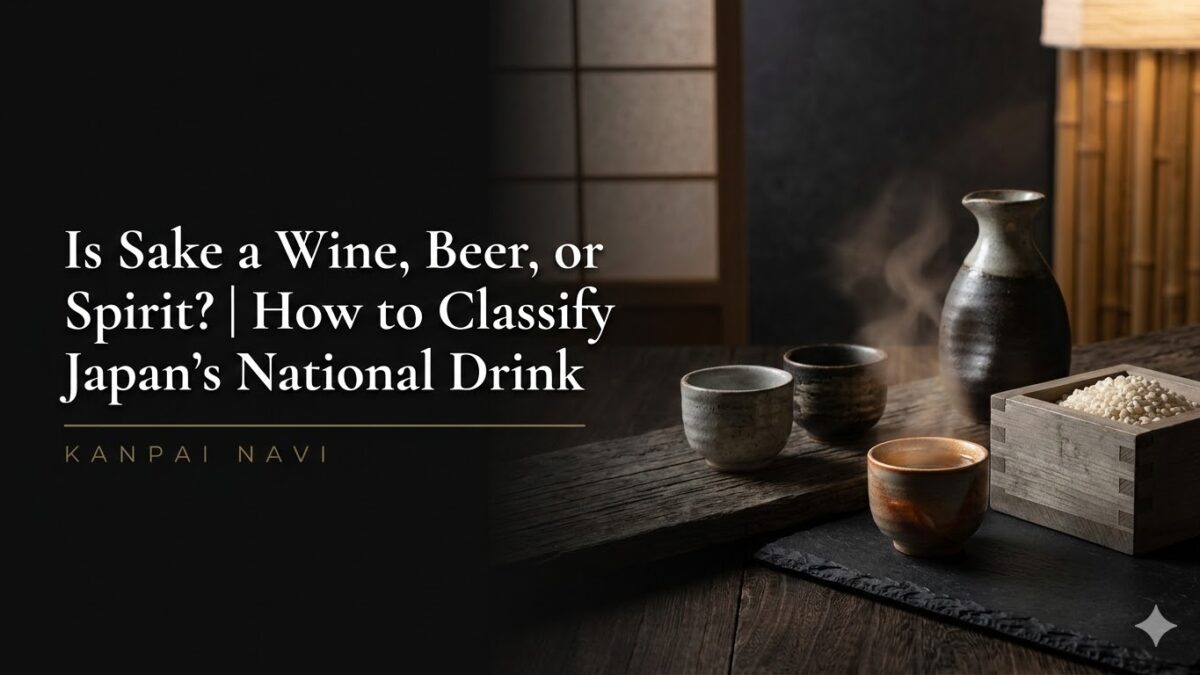
Is Sake a Wine, Beer, or Spirit? How to Classify Japan’s National Drink
What You’ll Learn in This Article
- Why sake earned the “rice wine” label — and why it is scientifically incorrect
- The grain-based reason sake shares more DNA with beer than wine
- Parallel fermentation decoded — the process that exists nowhere else on earth
- Sake vs wine vs beer vs spirits — a full multi-attribute comparison
- The definitive answer: how to classify this remarkable sake drink
Walk into any bar outside Japan and you will almost certainly find sake listed under “wine.” Ask your friends, and someone will confidently call it “rice wine.” The confusion is universal.
But sake’s ingredients and production tell an entirely different story. This brewed rice beverage does not fit neatly into any Western alcohol category — it is not wine, not beer, and certainly not a spirit. It is a singular drink shaped by centuries of Japanese brewing tradition and a fermentation process found nowhere else in the world.
Understanding how to classify this sake drink is more fascinating than you might expect. It starts with a deep look at how sake is actually made, moves through the science of koji mold and parallel fermentation, and ends with a definitive framework you can use the next time someone asks you: “So, is sake wine or beer?”
Supervised by
Daichi Takemoto
Authentic Bartender & Owner of Obanzai Nanchatte, Kobe
With 8 years of experience as a professional bartender and now the owner of "Obanzai Nanchatte" in Kobe, Daichi brings hands-on expertise in Japanese sake, whisky, and food pairing to every article on Kanpai Navi.
Table of Contents
- Why Sake Is Called “Rice Wine” — And Why the Label Is Wrong
- The Historical Origins of the “Rice Wine” Label
- Where the Wine Comparison Breaks Down Completely
- Why Sake’s Brewing Process Is Closer to Beer Than Wine
- The Shared Challenge: Converting Starch to Sugar
- The Starch Conversion Methods Compared
- Why Many Experts Call Sake a “Beer”
- Parallel Fermentation: The Process That Makes Sake Unique Among All Alcoholic Beverages
- What Is Multiple Parallel Fermentation (Heijou Fukuhakkou)?
- Why Parallel Fermentation Achieves Higher Alcohol Content
- The Moromi: Where the Magic Happens
- No Hops, No Carbonation, No Parallels
- Sake vs Wine vs Beer vs Spirits: The Complete Side-by-Side Comparison
- Understanding the Flavor Implications
- How to Actually Classify This Sake Drink: The Definitive Answer
- Sake in Japanese Law and Global Regulation
- A Practical Classification Framework
- Frequently Asked Questions
- Is sake a wine or a beer?
- Why is sake called rice wine if it is not actually wine?
- What type of alcohol is sake?
- Is sake stronger than wine?
- Is sake a spirit or liquor?
- Can sake be served hot like tea or cold like beer?
- The Bottom Line
- Sources & References
Why Sake Is Called “Rice Wine” — And Why the Label Is Wrong
The term “rice wine” has followed sake around the English-speaking world for well over a century. The reasons are partly historical, partly sensory, and partly a matter of convenience. Understanding why it stuck — and why it is fundamentally wrong — is the first step toward appreciating what sake truly is.
The Historical Origins of the “Rice Wine” Label
When European traders first encountered sake in the 16th and 17th centuries, they needed a familiar word for an unfamiliar drink. Sake was clear, still, relatively strong, and served with meals — all characteristics that matched wine. “Rice wine” was convenient shorthand, and it persisted through centuries of cross-cultural contact.
The Portuguese Jesuit missionaries who documented Japanese culture in the 1500s were among the earliest Westerners to describe sake. They framed it through a European lens because they had no other reference point. Centuries later, that same framing still dominates menus, textbooks, and the internet.
From a sensory standpoint, the comparison is not entirely baseless. Premium ginjo sake can display fruity, floral aromas that rival a crisp Riesling or Sauvignon Blanc. Both beverages pair beautifully with seafood and are sipped rather than gulped.
Where the Wine Comparison Breaks Down Completely
The problem is fundamental: wine is made by fermenting the natural sugars found in fruit. Crush grapes, add yeast, and the sugars convert directly into alcohol. This is called simple fermentation. Sake, on the other hand, starts with rice — a grain that contains starch but virtually no fermentable sugar.
That single difference changes everything about how the drink is made.
Rice cannot ferment on its own. Its energy is locked inside starch molecules that yeast cannot access without an intermediary conversion step. This is the critical distinction that separates sake from every wine on earth, whether made from grapes, apples, plums, or any other fruit.
| Attribute | Sake | Wine |
|---|---|---|
| Base ingredient | Rice (a grain) | Grapes (a fruit) |
| Sugar source | Starch converted by koji mold | Natural fruit sugars |
| Fermentation type | Multiple parallel fermentation | Simple fermentation |
| Key microorganism | Koji mold (Aspergillus oryzae) + yeast | Yeast only |
| Typical ABV | 13 to 17% | 12 to 15% |
| Acidity profile | Low acidity (succinic, lactic, malic acids) | Higher acidity (tartaric, malic, citric acids) |
| Amino acid content | Significantly higher (umami richness) | Lower |
As the table makes clear, the similarities between sake and wine are largely superficial. Once you examine what sake is actually made of, the production processes diverge dramatically. To find sake’s real cousin, we need to look at beer.
Why Sake’s Brewing Process Is Closer to Beer Than Wine
If sake is not wine, is it beer? At a fundamental level, sake and beer share the same starting challenge: both begin with a grain that is full of starch but contains no sugar for yeast to ferment. Solving that problem is what connects the two beverages — and separates both from wine.
The Shared Challenge: Converting Starch to Sugar
In beer brewing, starch conversion happens during a step called mashing. Malted barley is soaked in hot water, activating enzymes within the grain that convert starch into sugar. The sugary liquid (called wort) is drained off, and yeast is added to begin fermentation.
The key point: conversion happens first, fermentation happens second. These are two distinct, sequential stages.
Sake follows the same basic logic. Rice starch must become sugar before it can become alcohol. But instead of relying on malt enzymes and hot water, sake brewers use a remarkable mold called koji (Aspergillus oryzae). Koji is cultivated directly on steamed rice over approximately 48 hours in a temperature-controlled room called the kojimuro. Its enzymes — primarily amylase and glucoamylase — break down rice starch into glucose.
The Starch Conversion Methods Compared
The table below illustrates the parallel between beer and sake at the starch-conversion stage, highlighting the different biological mechanisms each uses to accomplish the same goal.
| Conversion Factor | Sake (Koji Method) | Beer (Malt Method) |
|---|---|---|
| Enzyme source | Aspergillus oryzae mold | Enzymes within malted barley |
| Conversion trigger | Mold growth on steamed rice | Hot water (62-72 C) on crushed malt |
| Time required | ~48 hours for koji preparation | ~60-90 minutes for mashing |
| End product | Glucose-rich koji rice | Sugary wort liquid |
| Ongoing during fermentation? | Yes — continues in the tank | No — completed before fermentation |
Why Many Experts Call Sake a “Beer”
Because both sake and beer are brewed from grain rather than fermented from fruit, many authorities argue that sake is technically closer to beer than wine. The U.S. Alcohol and Tobacco Tax and Trade Bureau (TTB) actually classifies sake as a beer for regulatory purposes. In Japan, the legal term is seishu (clear alcohol), which falls under its own distinct category in the Liquor Tax Act (Shuzeihou).
The grain-based, brewed nature of sake makes the beer comparison far more scientifically accurate than the wine comparison. But as we will see next, sake’s fermentation process is so different from beer’s that even this label ultimately falls short.
Daichi Takemoto
The TTB classification catches a lot of people off guard. When I mention that sake is legally “beer” in the United States, the reaction is always surprise. But it makes sense once you understand that the TTB classifies any fermented beverage made from grain as beer. Still, this regulatory shortcut completely ignores the parallel fermentation that makes sake fundamentally different from any ale or lager.
Parallel Fermentation: The Process That Makes Sake Unique Among All Alcoholic Beverages
Here is where things get truly interesting. While sake and beer both start with grain and both require starch-to-sugar conversion, the way sake handles that conversion is radically different — and it is what makes sake genuinely unique among all the world’s alcoholic beverages.
What Is Multiple Parallel Fermentation (Heijou Fukuhakkou)?
In beer, starch conversion and fermentation are separate, sequential steps. First you mash (convert starch to sugar), then you ferment (convert sugar to alcohol). In sake, these two processes happen simultaneously in the same tank.
Koji mold continuously converts rice starch into glucose while yeast continuously converts that glucose into alcohol — all at the same time. This is called heijou fukuhakkou (multiple parallel fermentation), and it is a biochemical balancing act that requires extraordinary precision from the brewer.
The following table compares the three major fermentation types across all beverage categories.
| Fermentation Stage | Wine (Simple) | Beer (Sequential) | Sake (Parallel) |
|---|---|---|---|
| Step 1 | Yeast ferments fruit sugar into alcohol | Malt enzymes convert starch to sugar (mashing) | Koji converts starch to sugar AND yeast ferments sugar to alcohol — simultaneously |
| Step 2 | — (single step) | Yeast ferments sugar into alcohol | — (single continuous step) |
| Pre-fermentation ABV potential | Determined by grape sugar content | Determined by wort sugar content | Not fixed — sugar continuously supplied |
| Final ABV (before any dilution) | 12 to 15% | 4 to 8% | 18 to 20% |
Why Parallel Fermentation Achieves Higher Alcohol Content
This parallel process is remarkably efficient. In wine and beer, the amount of sugar available at the start of fermentation sets a ceiling on how much alcohol yeast can produce. Once the sugar is consumed, fermentation stops.
In sake, that ceiling does not exist in the same way. Because koji is continuously producing new glucose from rice starch, yeast has a steady supply of fuel throughout the entire fermentation period (typically 18 to 32 days). The result is natural alcohol levels of 18% to 20% — far higher than beer and even higher than most wines.
No other fermented beverage in the world achieves such high alcohol content without distillation. This fact alone should disqualify the term “rice wine,” because wine yeast typically dies at around 15% to 16% ABV, while sake yeast strains have been selected over centuries for their ability to survive in much higher alcohol environments.
The Moromi: Where the Magic Happens
The fermentation mash in sake is called moromi. It is a thick, porridge-like mixture of steamed rice, koji rice, water, and yeast that churns and bubbles for weeks inside large open or closed tanks. The toji (master brewer) monitors temperature, acidity, and specific gravity daily, making adjustments to keep the koji and yeast in balance.
If the koji works too quickly, excess sugar accumulates and can stress or kill the yeast. If the yeast works too fast, it runs out of sugar and fermentation stalls. Managing this balance is the core skill of sake brewing and the reason the toji has historically been considered one of the most respected artisan roles in Japan.
Caution
A common misconception is that sake’s high natural ABV (18-20%) means the final product is always strong. In reality, most sake is diluted with water after pressing to bring the alcohol content down to 13-17%. Undiluted versions, called genshu, are the exception rather than the rule. Always check the label if you are watching your alcohol intake.No Hops, No Carbonation, No Parallels
Beyond fermentation, sake and beer diverge in other obvious ways. Beer relies on hops for bitterness, flavor, and preservation. Sake uses no hops whatsoever — its flavor complexity comes entirely from the interplay of koji enzymes, yeast strains, rice variety, and water mineral profile.
Beer is almost always carbonated; sake is almost always still (with rare sparkling exceptions). These differences are not minor — they affect aroma, mouthfeel, food pairing, and serving temperature.
| Characteristic | Sake | Beer |
|---|---|---|
| Bittering agent | None | Hops |
| Carbonation | Still (rarely sparkling) | Carbonated |
| Serving temperature range | 5 C to 55 C (chilled to hot) | 3 C to 12 C (cold only) |
| Amino acid richness | High (umami character) | Low to moderate |
| Color | Clear to pale yellow | Pale gold to deep brown/black |
| Glassware tradition | Ochoko, guinomi, wine glass | Pint glass, stein, tulip |
Sake’s still, hop-free character is one reason it can be enjoyed across an extraordinary range of temperatures — from well-chilled to piping hot — while beer is almost exclusively served cold.
Sake vs Wine vs Beer vs Spirits: The Complete Side-by-Side Comparison
Now that we have examined each comparison individually, the table below brings everything together. It compares sake against wine, beer, and spirits across nine key attributes so you can see the full picture at a glance.
| Attribute | Sake | Wine | Beer | Spirits |
|---|---|---|---|---|
| Base ingredient | Rice (grain) | Grapes (fruit) | Barley/wheat (grain) | Varies (grain, fruit, sugarcane) |
| Sugar source | Starch converted by koji mold | Natural fruit sugars | Starch converted by malt enzymes | Varies |
| Fermentation type | Multiple parallel fermentation | Simple fermentation | Sequential (mash then ferment) | Fermentation + distillation |
| Distilled? | No | No | No | Yes |
| Typical ABV | 13 to 17% | 12 to 15% | 4 to 8% | 40 to 60% |
| Carbonation | Usually still | Usually still | Carbonated | Still |
| Serving temperature | Chilled, room temp, or warm/hot | Chilled or room temp | Chilled | Varies |
| Key flavor agent | Koji mold + yeast strain + rice variety | Grape variety + terroir | Hops + malt | Base ingredient + aging vessel |
| Legal classification (US) | Beer (TTB) | Wine (TTB) | Beer (TTB) | Distilled spirit (TTB) |
As this comprehensive table makes clear, sake borrows traits from multiple categories. It shares grain origins with beer, alcohol strength with wine, and a still, uncarbonated profile that separates it from both. It is decidedly not a spirit, since it undergoes no distillation whatsoever.
The conclusion is inescapable: sake does not belong in any existing Western category.
Understanding the Flavor Implications
The brewing method directly shapes what sake tastes like. Because koji mold produces amino acids alongside glucose, sake has a naturally higher umami content than either wine or beer. This is why sake pairs so beautifully with savory dishes — the glutamic acid in the drink resonates with glutamic acid in foods like seafood, mushrooms, aged cheese, and dashi-based cooking.
Wine’s acidity comes primarily from tartaric and malic acids inherent in grapes. Sake’s much lower acidity comes from lactic and succinic acids produced during fermentation. This difference gives sake a rounder, softer mouthfeel compared to the bright, cutting acidity typical of many white wines.
Beer’s bitterness from hops has no equivalent in sake. Instead, sake can exhibit a gentle bitterness from certain yeast strains or higher amino acid levels, but it is far subtler and never dominates the palate.
Daichi Takemoto
Parallel fermentation is what I always point to when guests ask me whether sake is wine or beer. It is neither. The koji and yeast work together in a kind of controlled harmony that does not exist in any other brewing tradition. That balance is what gives sake its incredible range of flavors — from rich, savory junmai styles to light, fragrant ginjo expressions.
How to Actually Classify This Sake Drink: The Definitive Answer
So if sake is not wine, not beer, and not a spirit, what is it? The most accurate answer is simple and satisfying: sake is its own category of alcoholic beverage — a brewed rice drink produced through multiple parallel fermentation. The Latin term for this is sui generis, meaning “of its own kind.”
Sake in Japanese Law and Global Regulation
In Japan, sake has always been understood as its own thing. The Japanese Liquor Tax Act (Shuzeihou) classifies it as seishu — a legally defined category that is entirely separate from beer (biiru), wine (wain), and spirits (shouchu/whisky). There is no cultural confusion in Japan about what sake is, because nobody there tries to call it wine or beer.
The following table shows how sake is classified across major regulatory bodies worldwide.
| Country/Region | Regulatory Body | Sake Classification |
|---|---|---|
| Japan | National Tax Agency (NTA) | Seishu — its own legal category |
| United States | TTB (Alcohol and Tobacco Tax and Trade Bureau) | Beer (fermented grain beverage) |
| European Union | Various national authorities | Generally classified as “other fermented beverages” |
| United Kingdom | HMRC | “Made-wine” or “other fermented product” |
Many beverage professionals and sommeliers worldwide now prefer the unambiguous term sake (or its formal Japanese name, nihonshu, meaning “the alcohol of Japan”) rather than forcing it into a Western framework. This is the approach we recommend as well.
A Practical Classification Framework
For everyday purposes, here is a simple way to think about sake’s classification depending on the context.
| Context | Best Mental Model | Why |
|---|---|---|
| Choosing glassware or serving size | Think wine | Similar ABV (13-17%), similar portion sizes, similar food-pairing philosophy |
| Understanding production | Think beer | Both brewed from grain, both require starch-to-sugar conversion |
| Studying fermentation science | Think sake | Parallel fermentation has no equivalent in any other beverage |
| Legal/regulatory matters | Check local laws | Classification varies by country (see table above) |
| Casual conversation | Sake is sake | A uniquely Japanese brewed beverage with no true Western equivalent |
Whichever lens you use, the key takeaway is the same: sake occupies its own space. Once you stop trying to squeeze it into someone else’s category, you can start appreciating what sake actually tastes like on its own remarkable terms. See our guide on how to drink sake for practical tips on getting started.
Daichi Takemoto
When customers at my bar ask what sake is, I tell them: forget the categories. Sake is sake. Once you stop trying to compare it to wine or beer and just experience it on its own terms, that is when you really start to appreciate what makes it special. Pour a glass of good junmai, taste it warm and cold, and the answer becomes obvious. The drink itself is the best teacher.
Frequently Asked Questions
Is sake a wine or a beer?
Sake is technically neither. While it is often called “rice wine” because of its similar alcohol content (13 to 17% ABV), sake is brewed from grain like beer. However, its unique multiple parallel fermentation process — where starch conversion and alcohol fermentation happen simultaneously — sets it apart from both. The most accurate classification is that sake is its own distinct category of brewed alcoholic beverage.
Why is sake called rice wine if it is not actually wine?
The term “rice wine” became popular because early Western traders needed a familiar label for this Japanese drink. Sake’s alcohol content, still profile, and food-pairing versatility reminded them of wine, so the name stuck. The term is technically inaccurate because wine requires fruit sugar, while sake requires starch conversion from grain. You can learn more in our detailed guide to rice wine.
What type of alcohol is sake?
Sake is a brewed, undistilled alcoholic beverage made from rice, water, koji mold, and yeast. It is produced through multiple parallel fermentation, in which starch conversion and alcohol fermentation happen simultaneously. This process is unique to sake and does not exist in wine, beer, or spirit production. See what sake is made of for the full breakdown of ingredients.
Is sake stronger than wine?
Sake and wine have a similar alcohol range, but sake’s ceiling is higher. Most sake is bottled at 13 to 17% ABV, while wine typically falls between 12 to 15% ABV. Some undiluted (genshu) sakes can reach 18 to 20% ABV, which is stronger than nearly all wines. However, many modern breweries also produce lighter styles around 12 to 13% ABV. For a complete breakdown, see our guide to sake alcohol content.
Is sake a spirit or liquor?
No. Sake is not distilled, which is the defining characteristic of spirits and liquors. Spirits like vodka, whisky, and shochu undergo distillation to concentrate their alcohol content (typically 40% ABV and above). Sake achieves its alcohol content entirely through fermentation. For more on related Japanese beverages, see our guide to Japanese rice wine.
Can sake be served hot like tea or cold like beer?
Yes — and this versatility is one of sake’s most distinctive traits. Sake can be enjoyed at temperatures ranging from about 5 C (well-chilled) to 55 C (piping hot), with each temperature revealing different flavors and aromas. Rich, full-bodied styles like junmai often shine when warmed, while delicate, aromatic styles like ginjo are typically best chilled. See our guide on hot sake for serving temperatures and recommendations.
The Bottom Line
The question “Is sake a wine, beer, or spirit?” does not have a one-word answer — and that is precisely what makes this sake drink so remarkable. It shares wine’s elegance and alcohol strength. It shares beer’s grain-based, brewed origins. But its signature multiple parallel fermentation process belongs to sake alone, placing it in a category that Western alcohol taxonomy simply does not have a name for.
The next time someone asks you what sake is, you can confidently say: it is sake. A brewed rice beverage born from an ancient Japanese tradition that combines the work of koji mold and yeast in a way no other drink on earth replicates. Forget the comparisons — just pour a glass and discover its character for yourself.
Start with our guide to how to drink sake, or explore the differences between junmai and ginjo styles to find the sake that suits your palate.
Sources & References
- Bamforth, C. W. (2005). Food, Fermentation and Micro-organisms. Blackwell Publishing. — Comprehensive reference on fermentation biochemistry across beverage categories.
- Gauntner, J. (2002). The Sake Handbook. Tuttle Publishing. — Foundational English-language guide to sake production, classification, and tasting.
- Kitagaki, H. & Kitamoto, K. (2013). “Breeding Research on Sake Yeasts in Japan: History, Recent Technological Advances, and Future Perspectives.” Annual Review of Food Science and Technology, 4, 215-235.
- Machida, M. et al. (2008). “Genome Sequencing and Analysis of Aspergillus oryzae.” Nature, 438, 1157-1161. — Landmark study on the koji mold genome.
- Japan’s National Tax Agency. (2024). Comprehensive Guide to the Liquor Tax Act (Shuzeihou). — Official classification of seishu and other alcoholic beverage categories under Japanese law.
- U.S. Alcohol and Tobacco Tax and Trade Bureau (TTB). (2024). Beverage Alcohol Manual (BAM). — Federal guidelines for classification of sake as a malt beverage/beer product.
- Sake Service Institute (SSI). (2023). Sake Navigator Certification Curriculum. — Professional training materials on sake production and evaluation methodology.


